
Empowering Animation, VFX, Gaming, Comics & Extended Reality Ecosystems
Building India’s Next Creative Technology Powerhouse
Introduction
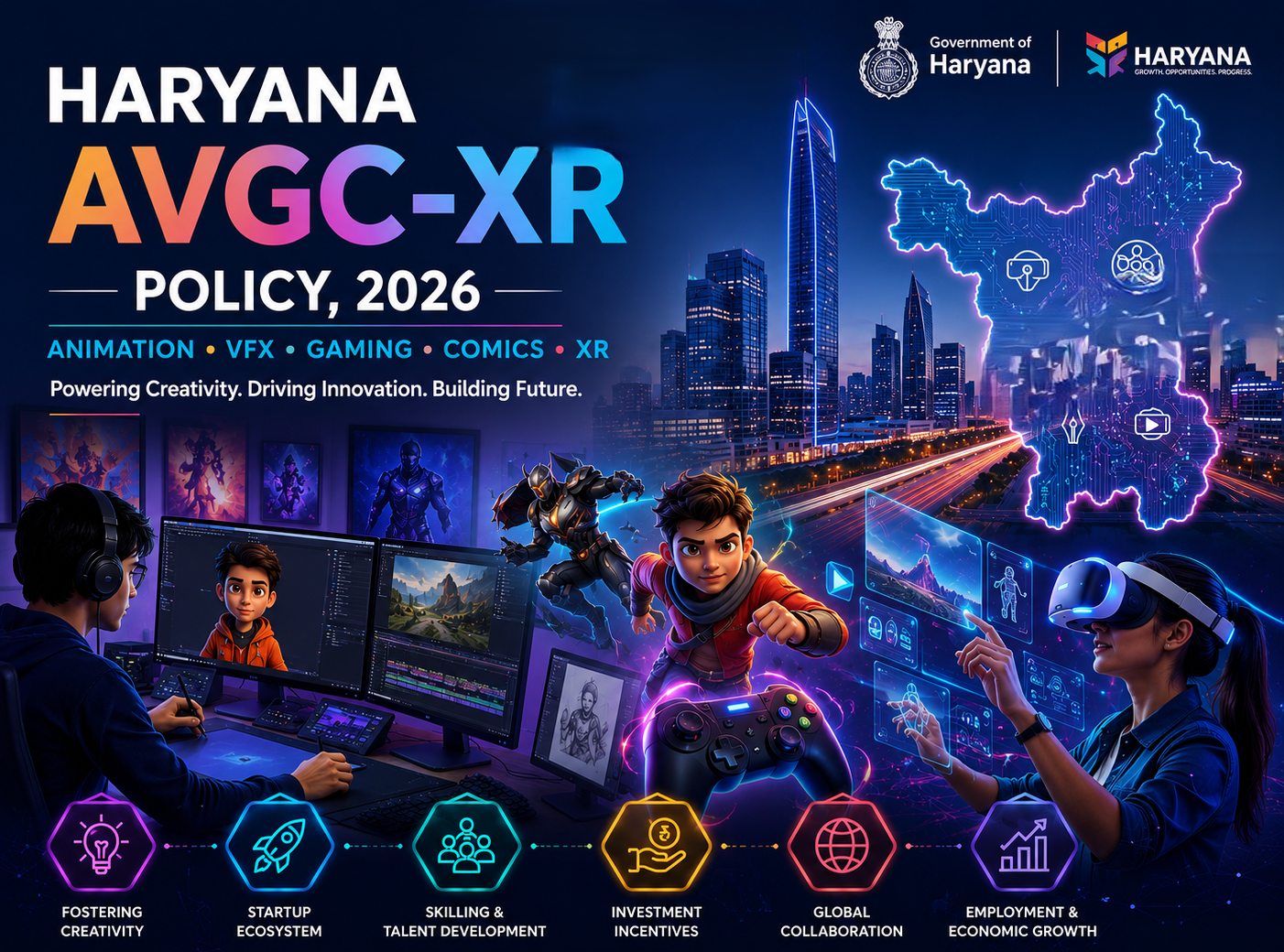
India’s creative technology landscape is undergoing a seismic transformation, and Haryana is positioning itself right at the epicentre of this revolution. The Haryana AVGC-XR Policy, 2026 represents a transformative step towards building a robust ecosystem for Animation, Visual Effects (VFX), Gaming, Comics, Augmented Reality (AR), Virtual Reality (VR), Extended Reality (XR), Virtual Production, Immersive Experiences, and Creative Technologies. With this bold policy initiative, the state is declaring its intent to be far more than a traditional industrial economy — it aspires to become a hub of imagination, innovation, and immersive tech.
Policy Context: Part of a Larger Industrial Vision
The AVGC-XR Policy does not exist in isolation. The policy was launched alongside the Make in Haryana Industrial Policy 2026 and nine sector-specific policies, with the event also witnessing the signing of investment MoUs worth over ₹1.10 lakh crore, highlighting the growing confidence of businesses and investors in Haryana’s future.
Haryana Chief Minister Nayab Singh Saini launched the Make in Haryana Industrial Policy 2026 in Gurugram, setting an ambitious target of attracting ₹5 lakh crore in investments over the next five years. The AVGC-XR Policy is one of the centrepieces of this broader vision, signalling that creative and digital industries are now considered as strategically vital as conventional manufacturing.
The policy signals a shift from traditional manufacturing towards innovation-led industrial growth, focusing on competitiveness, sustainability, exports, and job creation.
What is AVGC-XR?
AVGC-XR stands for Animation, Visual Effects, Gaming, Comics, and Extended Reality (which encompasses AR, VR, and Mixed Reality). It is one of the fastest-growing segments of the global digital economy.
From a market standpoint, the numbers are staggering. The global market size for animation and visual effects reached approximately USD 168 billion in 2021, and is predicted to expand to USD 290 billion by 2024, demonstrating a Compound Annual Growth Rate (CAGR) of 10.94% from 2020 to 2026. According to estimates by NITI Aayog, the animation and VFX sector in India was valued at USD 1.28 billion, which is expected to grow up to USD 13.1 billion.
The gaming segment is equally spectacular. The global gaming market, valued at USD 198.4 billion in 2020, is anticipated to reach USD 314.4 billion by 2026, growing at a CAGR of 9.64% between 2021 and 2026. The gaming sector in India stood at USD 1.9 billion, which is expected to grow up to USD 13.3 billion by FY30.
On the employment front, the AVGC-XR industry employs more than 1,80,000 professionals, a figure expected to increase to approximately 2 million by FY30.
Strategic Objectives of the Policy
The Haryana Government has articulated clear, multi-dimensional goals through this policy. As stated in the draft framework, “The Government of Haryana aims to create a robust ecosystem for the AVGC-XR industry to grow and prosper, thereby making Haryana an attractive destination for investments, along with creating employment.” The overarching objectives include:
- Positioning Haryana as a hub for the AVGC-XR sector at the national and global level
- Developing robust infrastructure for the AVGC-XR industry to flourish
- Increasing employment opportunities for the youth of Haryana
- Supporting IP creation and promoting homegrown intellectual property
- Attracting domestic and foreign investment into the creative technology space
Key Features and Incentive Framework
The policy offers a comprehensive incentive structure designed to reduce the fiscal burden on enterprises and spur growth.
Financial Incentives: The Government of Haryana will offer financial support to investors to increase economic activity within the sector, with incentives aimed at fostering growth in the AVGC-XR sector and developing a favourable industrial ecosystem. Ultra-Mega Projects shall be offered customised packages of incentives by Haryana Enterprises Promotion Centre.
One notable provision for employment-linked incentives specifies that the incentive is subject to a ceiling of ₹30 lakh per enterprise per annum, only if 50% of the employees in the enterprise are having permanent resident or domicile in Haryana, disbursed across three tranches throughout the policy period. This ensures that the benefits of the policy are directly channelled to the local population of the state.
Capital and Tax Support: The new policy will make the state a preferred investment destination by offering incentives such as capital support, tax benefits, skill development programmes and simplified business regulations.
Infrastructure and the Centre of Excellence Push
A significant pillar of the AVGC-XR Policy is the development of world-class physical and digital infrastructure. The policy has already catalysed major private-sector responses.
Inspired by this vision, HKI Media announced plans to establish a ₹10 Crore Center of Excellence (CoE) for AVGC-XR in Haryana, envisioned as a world-class hub for innovation, talent development, entrepreneurship, and intellectual property creation.
The proposed Center of Excellence will focus on advanced Research & Development, Animation, VFX, Gaming, Comics, AR, VR & XR, Virtual Production Technologies, Creative Technology Development, Immersive Experiences & Emerging Technologies, and Intellectual Property creation.
Talent Development and the Youth Dividend
Haryana’s policy is acutely aware that the AVGC-XR sector is talent-intensive. Skilling the state’s young workforce is therefore a cornerstone of the strategy.
The state government is working on skill development initiatives to equip youth with future-ready skills, training students in AI, machine learning, and data analytics from an early stage, enabling them to compete globally.
The FICCI AVGC-XR Forum, during consultations that shaped the policy, also suggested strengthening the e-sports ecosystem to create new opportunities for youth and enhance the state’s competitive edge. E-sports, as a formal industry, is rapidly professionalising in India, and Haryana — which has a proud tradition in competitive sports — is uniquely placed to become a leader in this emerging arena.
Haryana’s Competitive Advantage
Why Haryana? The state’s geographical, infrastructural, and demographic advantages make it a natural candidate for AVGC-XR leadership.
Chief Minister Nayab Singh Saini stated that Haryana is well placed to benefit from the expansion of the creative digital sector due to its infrastructure and connectivity. The state’s proximity to the National Capital Region (NCR), home to major media, entertainment, and technology companies, gives it an immediate catchment of industry partners, clients, and creative talent.
The AVGC-XR sector in Haryana, although at a nascent stage, is steadily gaining traction by attracting some of India’s leading AVGC-XR enterprises. In addition, there are close to 15 leading educational institutions in the state which specialise in this sector.
Governance Architecture: Single Window and Investment Facilitation
One of the distinguishing features of the 2026 policy framework is the significant emphasis on ease of doing business. The policy introduced an AI-enabled Single Window 2.0, officially called the Intelligent Investment Facilitation Portal, which bundles approvals, land allocation, incentives, and clearances on a single interface, using a smart AI agent, an AI investment blueprint generator, and a GIS-based system.
This is particularly relevant for AVGC-XR enterprises, many of which are startups and SMEs that lack the resources to navigate complex regulatory ecosystems. A streamlined, technology-first approvals mechanism significantly lowers the barriers to entry.
Haryana’s emphasis on time-bound incentive disbursal with statutory penalties for delays addresses a long-standing investor concern regarding subsidy uncertainty and administrative lag in industrial policy execution.
The National Policy Backdrop
Haryana’s move also aligns with the central government’s push for AVGC-XR as a strategic sector. The Indian government has recognised the potential of the AVGC sector and actively supports its growth through initiatives like the National Centre of Excellence in Animation, Gaming, and Visual Effects, along with various incentives and grants. Financial incentives, tax benefits, and infrastructure support are being extended to both startups and established players.
Haryana joins a growing list of states enacting dedicated AVGC-XR frameworks. Maharashtra, for instance, approved the Maharashtra AVGC-XR Policy 2025, laying out a vision extending up to 2050 with a financial plan of ₹3,268 crore. The inter-state competition for this sector is intensifying, and Haryana’s 2026 policy positions it as a serious contender for industry leadership.
Significance for Startups, Creators, and Entrepreneurs
The AVGC-XR Policy 2026 is not just about attracting large corporations. Its provisions are designed to nurture the entire creative economy ecosystem — from individual creators and micro-studios to large production houses.
As the CEO of HKI Media articulated on the policy’s launch, the Haryana AVGC-XR Policy 2026 is taking meaningful steps to create opportunities for creators, startups, students, and businesses operating in emerging sectors.
The Haryana AVGC-XR Policy 2026 is more than a policy announcement — it is a vision for the future. By bringing together government, industry, academia, startups, creators, and technology leaders, Haryana is laying the foundation for a globally competitive AVGC-XR ecosystem.
Challenges and the Road Ahead
While the policy’s ambitions are well-founded, execution will be the true test. Key challenges include:
- Talent pipeline gaps: Scaling from 15 specialised institutions to a state-wide skilling ecosystem takes time and sustained investment.
- IP monetisation: India has historically struggled with intellectual property commercialisation, and policy frameworks alone cannot resolve deep-rooted industry habits.
- Competing with established hubs: Mumbai, Hyderabad, and Bengaluru have decades of head-start in the AVGC space. Haryana must offer compelling enough incentives to redirect talent and capital flows.
- Infrastructure readiness: Virtual Production facilities and high-end rendering infrastructure require significant capital expenditure. The policy must ensure consistent disbursement.
Priority areas under the broader industrial policy that complement AVGC-XR include artificial intelligence, electronics, pharmaceuticals, startups, and R&D-led enterprises. The policy’s focus on innovation, research, and future industries is aimed at moving Haryana beyond conventional manufacturing towards higher-value economic activity.
Conclusion
The Haryana AVGC-XR Policy, 2026 is a landmark moment in the state’s industrial history. It signals a decisive pivot from a predominantly agrarian and traditional manufacturing economy to one that embraces creativity, technology, and the immersive digital future. With a robust incentive framework, a commitment to talent development, a clear IP creation mandate, and the backing of one of India’s most aggressive industrial policy frameworks in recent memory, Haryana has laid the groundwork for a genuinely transformative creative economy.
The policy’s success will ultimately be measured not just in rupees invested or jobs created, but in the quality of stories told, games built, worlds rendered, and intellectual properties born from the soils of Haryana — carrying its identity to screens and headsets across the globe.
Recent Comments