
When a Non-Resident Indian (NRI) sells a property in India, any profit arising from the transaction is generally taxable as Capital Gains. The tax treatment depends on the property’s holding period and determines whether the gain is classified as Short-Term Capital Gain (STCG) or Long-Term Capital Gain (LTCG). Accordingly, TDS provisions under the Income-tax law become applicable at the time of sale.
Key Highlights
- The sale of immovable property by an NRI may result in taxable capital gains in India.
- Capital gains are categorized as either short-term or long-term based on the period of ownership.
- TDS is required to be deducted under the applicable provisions of the Income-tax Act.
- Long-Term Capital Gains (LTCG): Taxable at the applicable rate, generally 12.5%, subject to surcharge and cess, as prescribed.
- Short-Term Capital Gains (STCG): Taxable at the applicable income-tax rates, which may be as high as 30%, plus surcharge and cess.
- Eligible NRIs can claim capital gains exemptions under the Section 54 series, subject to fulfillment of specified conditions.
- Proper tax planning can help reduce the overall tax burden and improve post-sale proceeds.
Who Is Considered an NRI for Tax Purposes?
Residential status is determined under the Income-tax Act. It does not depend on citizenship alone.
An individual is generally treated as a Non-Resident if the prescribed conditions for residency are not fulfilled during the relevant financial year.
Therefore, before purchasing any property, the buyer should verify the seller’s residential status carefully.
Why Does TDS Apply to NRI Property Transactions?
The Government introduced TDS provisions to ensure tax collection at the source of income.
When an NRI sells property in India, capital gains may arise. Consequently, the buyer must deduct tax before making payment.
These provisions are governed primarily by Section 195 of the Income-tax Act.
Unlike resident transactions, the buyer cannot rely on the property’s sale value alone. Instead, the applicable tax rates must be considered.
Section 195: The Governing Provision
Section 195 applies when a payment is made to a non-resident and the amount is taxable in India.
Therefore, whenever an NRI sells property, the buyer must deduct TDS before releasing the sale consideration.
Importantly, Section 195 applies irrespective of the property’s value.
Thus, even a small property transaction may attract TDS obligations.
Difference Between Resident and NRI Property Sales
Many taxpayers confuse Section 194-IA with Section 195.
Under Section 194-IA, a resident seller’s property transaction attracts TDS at a lower rate, subject to specified conditions.
However, when the seller is an NRI, Section 195 applies instead.
As a result, the TDS burden becomes significantly higher.
The buyer must identify the seller’s residential status before completing the transaction.
TDS Rates on Sale of Property by NRIs
The TDS rate depends upon the nature of capital gains.
1. Long-Term Capital Gains (LTCG)
If the property qualifies as a long-term capital asset, TDS is generally deducted at the applicable long-term capital gains rate.
In addition, surcharge and health and education cess may apply.
Therefore, the effective rate can be substantially higher than the basic rate.
2. Short-Term Capital Gains (STCG)
If the property is treated as a short-term capital asset, TDS is deducted at the applicable income-tax slab rates.
Again, surcharge and cess may increase the overall deduction.
Consequently, the final TDS amount may be significant.
TDS Is Deducted on the Sale Consideration
A common misconception exists among buyers.
Many believe that TDS should be deducted only on capital gains.
However, unless a lower deduction certificate is obtained, TDS is generally deducted on the entire sale consideration payable to the NRI.
As a result, the amount deducted may exceed the actual tax liability.
Lower or Nil Deduction Certificate
Fortunately, relief is available.
An NRI may apply to the Income Tax Department for a lower deduction certificate.
After examining the capital gains computation, the tax authority may allow deduction at a reduced rate.
In some cases, a nil deduction certificate may also be issued.
Once the certificate is granted, the buyer can deduct tax according to the approved rate.
Therefore, obtaining this certificate can improve cash flow significantly.
Procedure for the Buyer
The buyer must comply with several tax requirements.
First, the buyer should obtain the seller’s PAN.
Next, the applicable TDS must be calculated.
Thereafter, the tax should be deducted at the prescribed rate.
The deducted amount must be deposited with the Government within the stipulated time.
Subsequently, TDS returns should be filed.
Finally, the buyer should issue the relevant TDS certificate to the seller.
Proper records should also be maintained.
Consequences of Failure to Deduct TDS
Non-compliance can become costly.
If TDS is not deducted, the buyer may be treated as a defaulting taxpayer.
Interest may be charged on the unpaid amount.
Additionally, penalties may be imposed.
In certain situations, prosecution provisions may also apply.
Therefore, compliance should never be ignored.
Capital Gains Tax Liability of the NRI
TDS is not the final tax.
Instead, it is merely a mechanism for advance tax collection.
The NRI must compute the actual capital gains and file the income tax return.
Thereafter, the final tax liability is determined.
If excess TDS has been deducted, a refund can be claimed.
Conversely, additional tax may need to be paid if the liability exceeds the TDS amount.
Can an NRI Claim Exemptions?
Yes. Various exemptions may be available subject to prescribed conditions.
For example, exemptions may be claimed on reinvestment in specified assets.
However, eligibility depends on the facts of each case.
Therefore, proper tax planning becomes essential before selling the property.
Professional advice can also help maximize legitimate tax benefits.
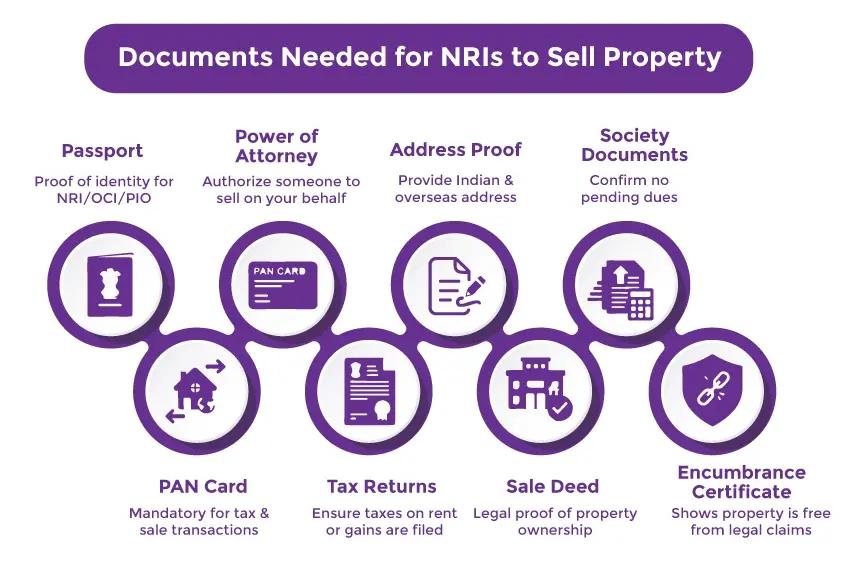
Documents Commonly Required
The following documents are generally required during the transaction:
- Permanent Account Number (PAN)
- Property purchase documents
- Sale agreement
- Capital gains computation
- Tax residency details
- Lower deduction certificate, if applicable
- Bank account information
- TDS payment records
Proper documentation helps ensure smooth compliance.
Practical Example
Suppose an NRI sells a property for ₹1 crore.
The buyer must examine the applicable TDS provisions under Section 195.
If no lower deduction certificate is available, TDS may be deducted on the entire sale consideration at the applicable rate.
Thereafter, the NRI can calculate the actual capital gains while filing the income tax return.
If excess tax has been deducted, a refund may be claimed from the Income Tax Department.
Key Points for Buyers
- Verify the seller’s residential status.
- Obtain the seller’s PAN.
- Determine the correct TDS rate.
- Deduct tax before making payment.
- Deposit TDS within the prescribed time.
- File the required TDS returns.
- Maintain proper documentation.
These steps can prevent future tax disputes.
Conclusion
TDS on Sale of Property by NRIs in India is a critical compliance requirement. Section 195 places significant responsibilities on buyers. Therefore, every transaction involving an NRI seller requires careful tax analysis.
Moreover, incorrect deduction can result in interest, penalties, and litigation. On the other hand, proper planning can reduce compliance risks substantially.
Both buyers and NRIs should review the tax implications before executing the sale. With accurate documentation and timely compliance, the transaction can be completed smoothly and efficiently.
Recent Comments