
Why Every Salaried Employee Should Pay Attention
Many salaried employees focus only on their own NPS contributions at tax time. However, they often overlook one of the most powerful tax benefits available to them. Section 80CCD(2) covers the tax treatment of your employer’s contribution to your NPS account. Understanding this provision can meaningfully reduce your tax liability each year.
What Is the National Pension System?
The National Pension System, commonly called NPS, is a government-sponsored retirement savings scheme. It allows both salaried employees and self-employed individuals to build a retirement corpus over time. NPS invests your money across equity, government bonds, and corporate debt, offering market-linked returns.
Furthermore, NPS is regulated by the Pension Fund Regulatory and Development Authority (PFRDA). It operates through two account types — Tier I and Tier II. Only Tier I contributions qualify for tax deductions under Section 80CCD.
Understanding Section 80CCD and Its Three Parts
Section 80CCD of the Income Tax Act governs all NPS-related tax deductions. It has three distinct sub-sections, each covering a different type of contribution.
Section 80CCD(1) covers your own contribution to NPS as an employee or self-employed individual. The deduction falls within the overall ₹1.5 lakh ceiling under Section 80CCE. Therefore, it counts alongside your 80C investments.
Section 80CCD(1B) allows an additional deduction of up to ₹50,000 on your own NPS contributions. This benefit sits completely outside the ₹1.5 lakh limit. Consequently, it can take your total NPS self-contribution deduction up to ₹2 lakh. However, this sub-section applies only under the old tax regime.
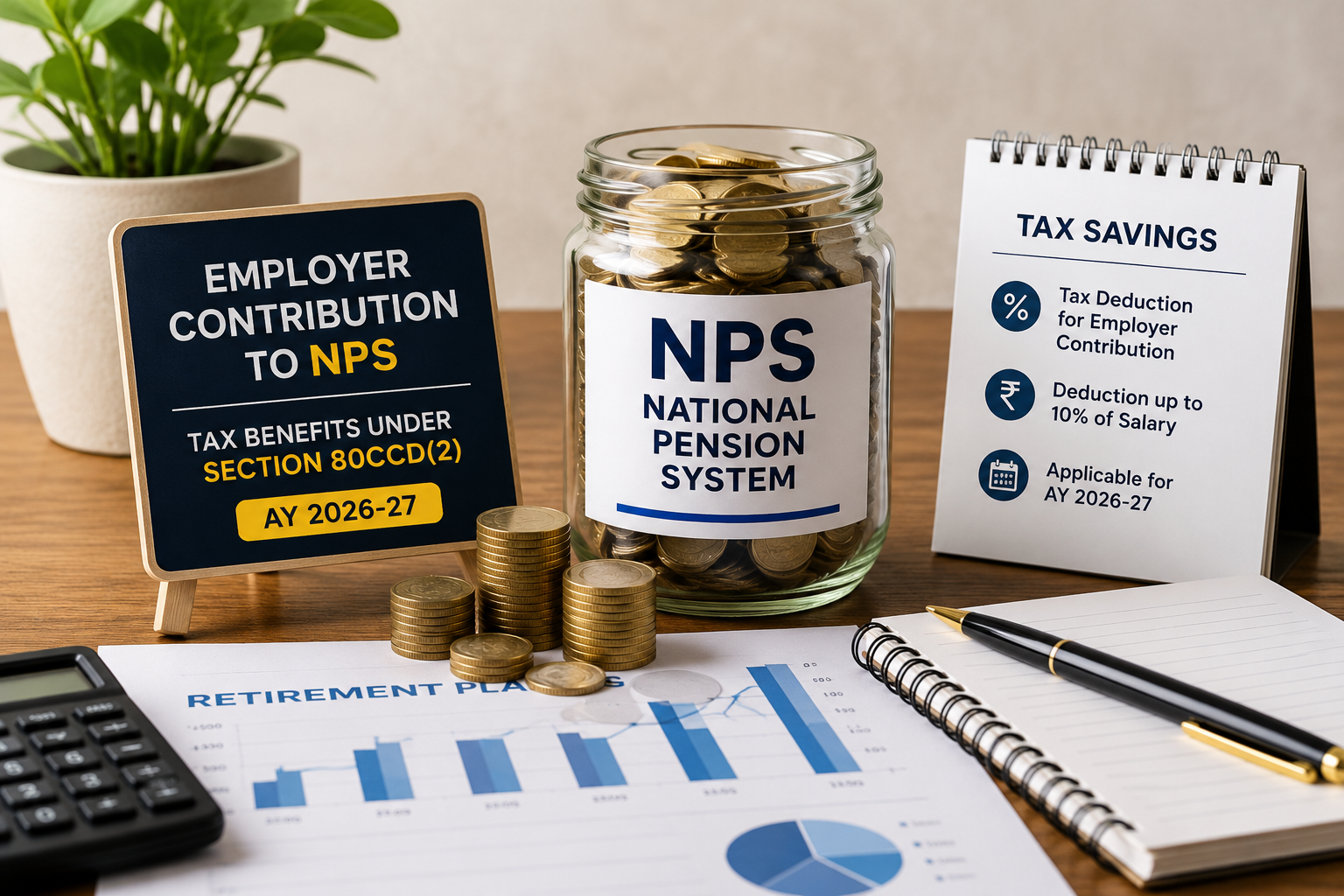
Section 80CCD(2) is the focus of this article. It specifically covers the employer’s contribution to an employee’s NPS account. Unlike the other two sub-sections, this benefit works under both the old and the new tax regimes.
What Is Section 80CCD(2) Exactly?
Section 80CCD(2) lets salaried employees claim a tax deduction on the amount their employer puts into their NPS account. The deduction is separate from all other tax-saving limits. Importantly, it does not fall under the ₹1.5 lakh ceiling of Section 80C or Section 80CCE.
In practice, the employer first adds this NPS contribution to the employee’s salary as a perquisite. Subsequently, the employee claims it back as a deduction under Section 80CCD(2). The net result is that the employer’s contribution never actually gets taxed in the employee’s hands.
What Are the Deduction Limits for AY 2026-27?
For Assessment Year 2026-27, covering income earned during Financial Year 2025-26, the deduction limits under Section 80CCD(2) are as follows.
For employees who choose the new tax regime, the deduction limit is 14% of salary (Basic + Dearness Allowance). This applies uniformly to all employees, including those in the private sector. This is a key update introduced by the Finance Act 2024, effective from April 1, 2025.
For employees under the old tax regime, private sector employees can claim up to 10% of salary (Basic + DA). Central and State Government employees under either regime can claim up to 14% of salary.
Therefore, AY 2026-27 is significant because private sector employees on the new regime now enjoy the same 14% limit as government employees. This is a meaningful improvement over the previous 10% ceiling.
A Practical Example to Understand the Benefit
Consider Ramesh, a private sector employee on the new tax regime. His annual basic salary is ₹12,00,000. His employer contributes 10% of his basic salary — that is ₹1,20,000 — to his NPS account each year.
Under Section 80CCD(2), Ramesh can claim the full ₹1,20,000 as a deduction. This is well within the 14% ceiling of ₹1,68,000 applicable for AY 2026-27. As a result, Ramesh reduces his taxable income by ₹1,20,000 without spending any extra money himself.
Moreover, if Ramesh’s employer raises the contribution to 14% (₹1,68,000), his tax saving increases further. Under the new regime at a 30% tax slab, this translates to approximately ₹34,944 in annual tax savings, at no additional personal cost.
The ₹7.5 Lakh Combined Cap You Must Know
There is one important overall limit that employees must track. The combined annual contribution from an employer across three instruments — NPS, Provident Fund, and Superannuation Fund — must not exceed ₹7,50,000.
If the total employer contribution across all three exceeds ₹7,50,000 in a financial year, the excess amount becomes taxable as a perquisite in the employee’s hands. Therefore, employees receiving high employer contributions across multiple instruments should monitor this threshold carefully.
Who Can Claim This Deduction?
Only salaried employees whose employer actively contributes to their NPS Tier I account can claim this deduction. Consequently, self-employed individuals cannot use Section 80CCD(2), since there is no employer making contributions on their behalf.
Additionally, both Indian residents and Non-Resident Indians (NRIs) aged between 18 and 70 years can participate in NPS and claim eligible deductions.
Why This Benefit Shines Under the New Tax Regime
The new tax regime eliminated most popular deductions. Standard NPS deductions under Section 80CCD(1) and Section 80CCD(1B) are not available under the new regime. However, Section 80CCD(2) is a notable exception — it continues to work fully.
Therefore, for employees who have chosen the new tax regime, negotiating an employer NPS contribution is one of the smartest tax-planning moves available. It delivers real tax savings without requiring any change in personal investment habits.
How Does the Employer Benefit?
The employer also gains from making NPS contributions. Employer contributions to NPS up to 14% of an employee’s salary qualify as a business expense. Accordingly, employers can deduct these amounts under Section 36(1)(iv)(a) of the Income Tax Act.
This creates a win-win arrangement. The employer reduces its corporate tax liability, while the employee gains a tax-free salary component that builds long-term retirement wealth.
Tax Treatment at Withdrawal
Understanding the tax picture at withdrawal is equally important. At retirement (age 60), an employee can withdraw up to 60% of the accumulated NPS corpus as a lump sum. This withdrawal is completely tax-free under Section 10(12A).
However, the remaining 40% must go toward purchasing an annuity. The annuity income received in subsequent years is taxable as regular income at the applicable slab rate. Therefore, NPS follows an Exempt-Exempt-Taxed (EET) model for this portion.
Furthermore, partial withdrawals of up to 25% of self-contributions are allowed after three years of NPS membership. These partial withdrawals are fully tax-free under Section 10(12B), subject to permitted reasons such as medical treatment, house purchase, or children’s education.
Important Note on the New Income Tax Act 2025
From Tax Year 2026-27 onward (income earned from April 1, 2026), Section 80CCD will be replaced by Section 124 of the new Income Tax Act 2025. However, for AY 2026-27, the provisions of the Income Tax Act 1961 still apply in full.
The substantive rules and deduction limits remain unchanged under the new framework. Therefore, the transition does not affect how employees file their returns for AY 2026-27.
Conclusion: Do Not Leave This Benefit on the Table
Section 80CCD(2) remains one of the most underutilized tax benefits for salaried employees in India. It works across both tax regimes, carries no fixed rupee cap, and sits outside the standard ₹1.5 lakh 80C ceiling. Furthermore, the Finance Act 2024 has now extended the 14% limit uniformly to all employees under the new regime from FY 2025-26.
If your employer does not yet contribute to your NPS account, this is the right time to initiate that conversation. The savings are real, the mechanism is simple, and the retirement benefit makes it doubly worthwhile.
Recent Comments