
Focus on Transformation From Fields to Fibre: Haryana’s Bold Leap into the AI Era
Driving Innovation • AI Leadership • Digital Transformation • Future-Ready Workforce
Haryana has always been a quiet powerhouse of India’s economy. Now, however, the state is making bold moves in the technology space. The Haryana IT/ITeS, AI and Emerging Technologies Policy 2026 signals a major shift. Moreover, it places Haryana firmly on the national and global technology map.
What Is This Policy?
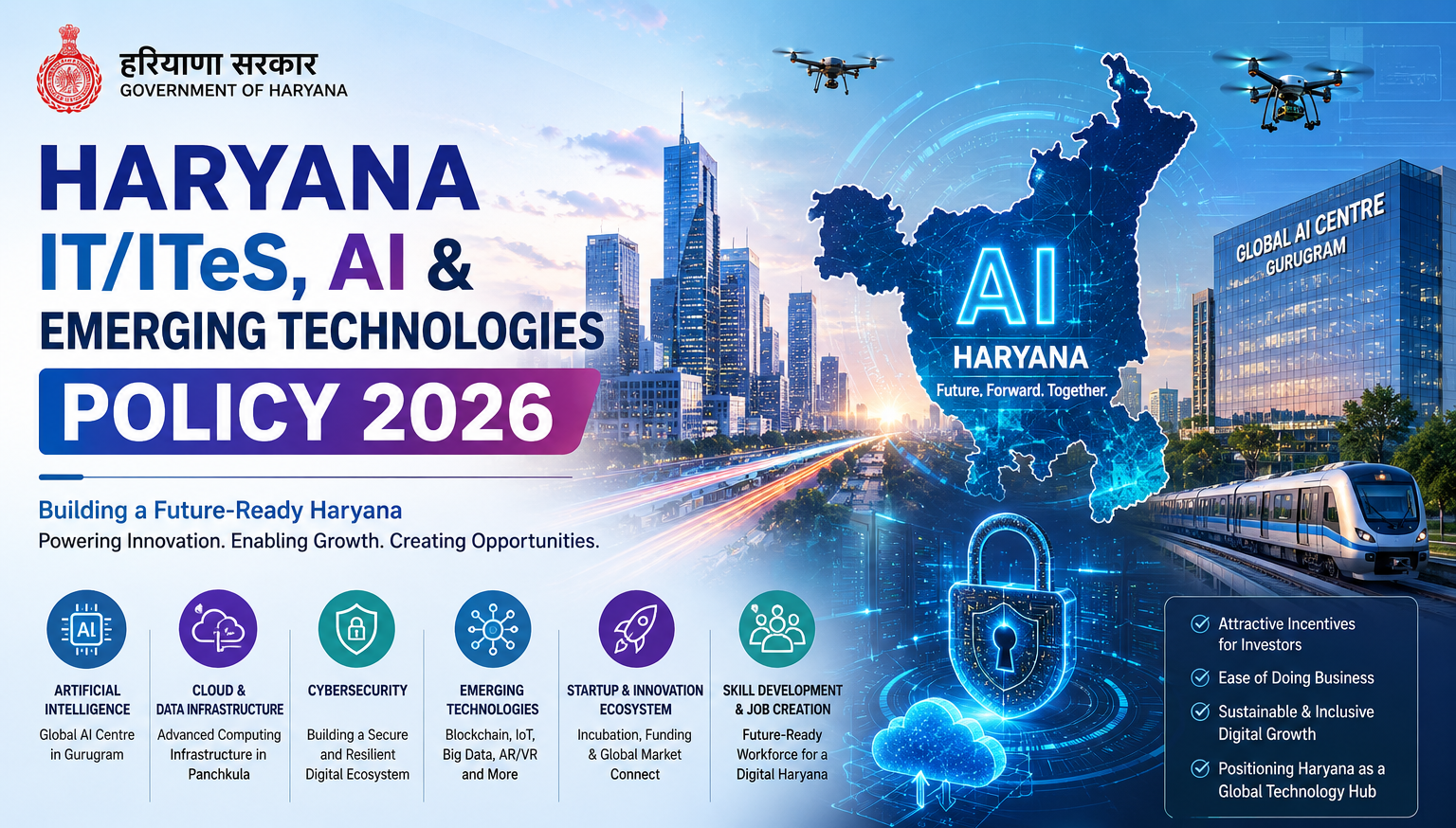
In early 2026, the Government of Haryana officially approved the IT/ITeS, AI and Emerging Technologies Policy 2026. Additionally, it launched the Haryana Global Capability Centers (GCC) Policy 2026 alongside it. Together, these two frameworks form the backbone of the state’s technology ambition.
Chief Minister Nayab Singh Saini unveiled the policies in Gurugram. Furthermore, they were launched alongside nine other sector-specific policy frameworks. The overarching goal is clear: attract global technology firms, create high-value jobs, and build world-class digital infrastructure.
Why This Policy Matters Now
India’s technology economy is growing rapidly. Therefore, states that act early will gain the most. Haryana already has Gurugram, one of India’s most important corporate hubs. Consequently, the state holds a natural advantage over many competitors.
However, advantage alone is not enough. The new policy provides the legal, financial, and structural support that technology companies need. As a result, both domestic startups and global enterprises now have a clear roadmap to invest in Haryana.
The Haryana AI Mission: Cornerstone of the Policy
A central feature of the 2026 policy is the Haryana AI Mission. This initiative positions Haryana as a premier hub for artificial intelligence innovation. Furthermore, it focuses on research, application, and large-scale deployment of AI tools.
The World Bank is backing the mission with approximately ₹470–₹474 crore in financial assistance. Thus, the funding base is both large and internationally credible. The mission integrates four key areas: advanced infrastructure, skills development, startup support, and AI-driven governance reforms.
Building World-Class AI Infrastructure
One of the most exciting parts of the policy is the infrastructure push. The state plans to establish a Global Artificial Intelligence Centre (GAIC) in Gurugram. In addition, it will develop an Advanced Computing Facility in Panchkula.
These two centres will serve as anchors for AI research and development. Moreover, they will attract researchers, engineers, and global technology firms to the state. Together, these facilities represent a serious investment in Haryana’s long-term digital future.
Skilling 50,000 Young People
Policies succeed only when people can benefit from them. Therefore, skill development occupies a central place in this framework. The state has committed to training 50,000 young people over three years, from 2025 to 2028.
The training covers emerging technologies such as artificial intelligence, machine learning, and data science. Consequently, Haryana aims to build a workforce that is ready for the jobs of tomorrow. Furthermore, this large-scale programme strengthens employability and supports AI-driven startups across the state.
Attracting Global Capability Centres (GCCs)
The Haryana GCC Policy 2026 works hand-in-hand with the IT/ITeS framework. Specifically, it targets multinational companies that want to set up capability centres in India. Gurugram, with its proximity to Delhi and excellent airport access, is an ideal location for such firms.
The policy offers several financial benefits. For instance, companies receive rent discounts, stamp duty reimbursements, and electricity duty exemptions in designated development zones. Furthermore, a one-window clearance system ensures fast and predictable approvals. This reduces the red tape that often frustrates investors.
Additionally, the policy promotes the development of Centres of Excellence in areas like cybersecurity and artificial intelligence. By 2030, the framework aims to create thousands of high-quality, well-paying technology jobs across the state.
The ‘Single Window 2.0’ Revolution
One practical highlight of the broader 2026 policy package is the AI-enabled Single Window 2.0 system. This unified digital platform handles approvals, land allocation, incentives, and investment support in one place. As a result, businesses can begin operations faster and with far less confusion.
Previously, investors had to navigate multiple government departments. Now, however, everything happens through a single, intelligent interface. Therefore, the time and cost of starting a new technology venture in Haryana drops significantly.
The Make in Haryana Industrial Policy: A Broader Context
The IT/ITeS and AI policies sit within a larger economic vision. In June 2026, Chief Minister Saini launched the ‘Make in Haryana’ Industrial Policy 2026. Alongside it, the state set an ambitious target of attracting ₹5 lakh crore in investments over five years.
On the very first day of its launch, Haryana signed Memorandums of Understanding worth ₹1.10 lakh crore. Moreover, this included ₹30,000 crore in foreign direct investment commitments. One landmark deal involved Anant Raj Limited, which committed ₹20,000 crore for large-scale data centre infrastructure across the state.
Data Centres: The New Oil Fields
Data centres have become critical pieces of digital infrastructure globally. Accordingly, Haryana’s 2026 policies give focused attention to this sector. The GCC and Data Centre Policy 2026 prioritises investments in non-transit oriented development zones in Gurugram.
The Anant Raj data centre project alone is expected to generate around 6,000 direct and indirect jobs. Furthermore, the project targets a capacity of 307 MW by the financial year 2032. This investment strengthens Haryana’s position in cloud computing, digital storage, and data connectivity.
Fiscal Incentives That Make Sense
Beyond large projects, the policy also supports smaller enterprises. Fiscal incentives now link to employment generation, research and development, export turnover, and green initiatives. Additionally, companies receive a 50% top-up on central government scheme benefits.
Sustainability also receives special attention. For instance, subsidies cover renewable energy adoption, zero liquid discharge systems, and carbon credit generation. Therefore, the policy encourages growth that is not only economically productive but also environmentally responsible.
AI-Led Governance: Smarter Services for Citizens
The Haryana AI Mission also focuses on making government itself more efficient. AI tools will strengthen data-driven service delivery across government departments. Furthermore, the state wants to integrate technology into daily governance for faster, more accurate citizen services.
This is a significant step forward. Traditionally, government services in India have been slow and paper-heavy. However, by embedding AI into administration, Haryana aims to offer citizens a smarter, more responsive government experience.
The Vision: Speed, Trust, and Partnership
Chief Minister Saini has summarised the policy philosophy in two words: speed and trust. He rightly points out that today’s investors do not simply look for financial incentives. Instead, they evaluate the entire ecosystem — decision-making speed, regulatory clarity, and long-term reliability.
Haryana’s policy framework directly addresses these concerns. Moreover, the state positions itself not just as a location for investment, but as a long-term growth partner. This framing is both modern and strategically sound.
Challenges Ahead
No policy is perfect, and this one faces real challenges too. First, translating ambitious targets into on-the-ground results requires strong implementation. Second, the competition from states like Karnataka, Telangana, and Tamil Nadu is intense. Nevertheless, Haryana’s geographic advantage, combined with its policy clarity, gives it a genuine edge.
Furthermore, the 50,000-person skilling programme must match actual industry demand. Otherwise, trained workers may struggle to find matching jobs. Therefore, regular review and course correction will be essential to the mission’s success.
What This Means for Businesses and Citizens
For technology companies, this policy offers a predictable and well-incentivised environment. For job seekers, it promises thousands of high-paying, future-ready careers. For citizens, it holds the potential for faster, smarter, and more transparent government services.
In short, the Haryana IT/ITeS, AI and Emerging Technologies Policy 2026 is not just a government document. Rather, it is a blueprint for a more prosperous, more competitive, and more inclusive Haryana. The foundation is now in place. What matters next is execution.
Recent Comments