
A Green Industrial Revolution
Turning Old Gadgets into Green Gold
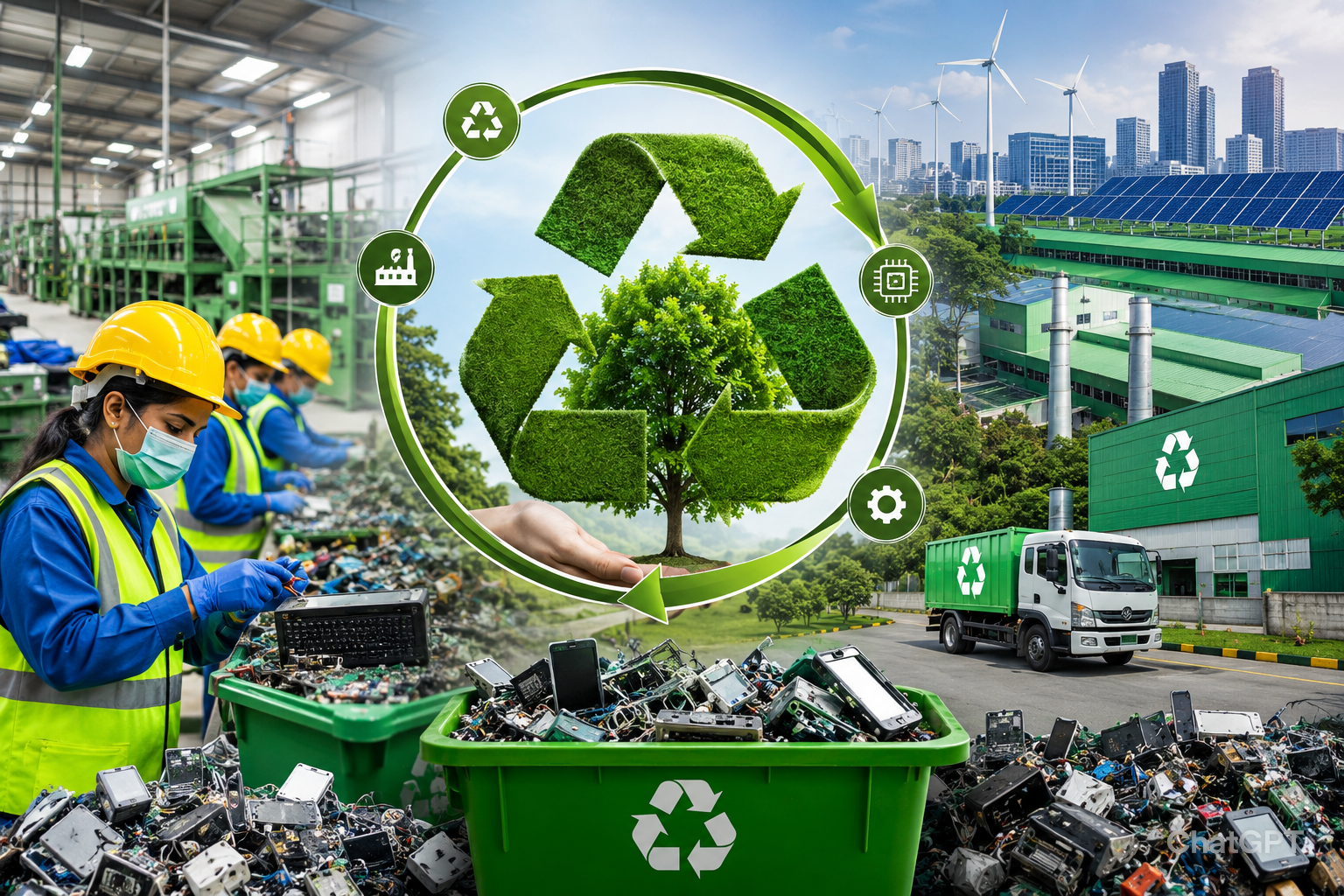
Every year, millions of old phones, laptops, and televisions pile up across Indian homes. Most end up in backyards, open drains, or illegal dump sites. Haryana has decided to change that story. In May 2026, the Haryana Cabinet approved the Draft Haryana Electronics Waste Recycling Policy, 2026. This bold move aims to turn electronic trash into industrial treasure.
The Growing E-Waste Crisis in India
E-waste simply means any old or broken electronic device. Think of dead mobile phones, worn-out laptops, broken TVs, and old refrigerators.
Around 50 million tonnes of e-waste pile up across the world every year. Only about 20% of that gets proper recycling. Workers burn or illegally trade the remaining 40 million tonnes.
Consequently, toxic metals like lead and mercury leak into soil and water. Therefore, a proper recycling system protects not just the environment but public health too.
Why the numbers keep climbing
More people now own smartphones, laptops, and smart appliances than ever before. As a result, the volume of discarded devices grows year after year.
The global e-waste recycling market is set to hit USD 137.6 billion by 2029, up from USD 66.61 billion in 2023. India’s own e-waste market will grow at a rate of 13.52% per year, jumping from USD 1.5 billion in 2022 to USD 4.5 billion by 2031.
Clearly, this is a sector with enormous economic potential.
Why Haryana Is the Right State for This Policy
A natural e-waste hub
Haryana sits right next to Delhi, one of India’s biggest cities. That location gives it a huge advantage in e-waste collection.
Haryana processes roughly 40% of Delhi-NCR’s electronic waste, giving recyclers a steady supply chain. Cities like Faridabad, Gurugram, and Panipat have already set themselves up as e-waste processing centres.
Furthermore, the state generates over 85,000 metric tonnes of e-waste each year as of 2024. That volume creates both a challenge and a massive business opportunity.
Strong industrial infrastructure already in place
Haryana’s strategic location near Delhi-NCR and its robust industrial infrastructure give e-waste entrepreneurs excellent advantages.
In addition, existing players like Endeavor Recyclers in Faridabad have already shown that formal recycling plants can work profitably in this region. New entrants now have a clear path to follow.
What the Cabinet Approved in May 2026
Twin policies for a unified vision
The Haryana Cabinet approved both the Draft Haryana Electronics System Design and Manufacturing Policy 2026 and the Draft Haryana Electronics Waste Recycling Policy 2026. Together, they bring electronics production, semiconductor supply chains, and recycling infrastructure under one unified sector roadmap.
CM Nayab Singh Saini also launched the wider ‘Make in Haryana’ Industrial Policy alongside nine sector-specific policies. The government targets ₹5 lakh crore in investments and 10 lakh new jobs across the state.
A part of Budget 2026–27 promises
The Cabinet took these decisions as part of the government’s wider industrial roadmap, linked directly to its Sankalp Patra commitments and Budget 2026–27 announcements.
Thus, the e-waste policy is not an isolated initiative. It forms one strong pillar of Haryana’s broader economic plan.
Financial Incentives: What Businesses Will Get
Capital and operational support
This is where the policy becomes very attractive for investors and entrepreneurs.
E-waste recycling units will receive 30% capital assistance, capped at ₹25 crore per unit. They will also get 70% operational assistance for five years, limited to ₹2 crore annually.
Additional benefits that lower costs
Employment incentives and stamp duty waivers further cut business costs. The government also grants EPR (Extended Producer Responsibility) authorization certificates within 30 days.
In short, the government lowers both the starting cost and the running cost for recyclers. That makes it far easier for new businesses to enter this sector and stay profitable.
The IMT Sohna Cluster: A 500-Acre Electronics Hub
Haryana’s biggest electronics project
One of the most exciting parts of this policy package is a large new infrastructure project near Delhi.
The state plans a 500-acre electronics manufacturing cluster at IMT Sohna near Delhi-NCR. Haryana wants to make this cluster a hub for electronics production, electronic components, and future semiconductor supply chains.
Semiconductors coming next
Haryana is also preparing a separate semiconductor policy to strengthen its position in India’s growing chip manufacturing ecosystem.
Therefore, the e-waste recycling policy is just one part of a much larger electronics story that Haryana is writing right now.
Building a Circular Economy: From Trash to Raw Material
Waste becomes a resource
The policy goes well beyond simply collecting old gadgets. Its deeper goal is to build a circular economy where nothing goes to waste.
Officials designed the broader framework to convert discarded electronic devices into reusable industrial raw material for next-generation electronics manufacturing. It also aims to reduce dependence on informal recycling networks and create green jobs in the process.
In other words, the battery from your old phone could power a new industrial product tomorrow. As a result, waste stops being a problem and starts being a raw material.
The government’s long-term vision
The Government of Haryana wants to build a sustainable circular economy where e-waste works as a valuable resource, re-entering the supply chain instead of filling up landfills.
This approach also reduces the need to mine new metals and minerals. Consequently, electronics manufacturing becomes cleaner and more sustainable over time.
Government Procurement Preference: A Ready Market for Recyclers
Local recyclers get first access
Beyond subsidies, the policy also gives registered recyclers a market advantage.
The state has decided to give preference to electronics products from Haryana in government procurement. Haryana-registered recycling units will also get preference in government contracts.
This means a new recycling business in Haryana starts with a reliable government customer from day one. Furthermore, that steady income helps businesses grow faster and invest in better technology.
Cleaning Up the Informal Sector
Millions of workers at risk
One of India’s biggest e-waste problems is its massive informal sector. Thousands of unregistered workers currently dismantle electronics without any safety equipment, legal protection, or environmental controls.
The recycling framework seeks to formalise e-waste collection, segregation, certification, and material recovery systems as digital consumption and e-waste generation keep rising rapidly. By bringing these activities under proper rules, the policy also protects workers from toxic exposure. Moreover, certified recycling stops harmful chemicals from reaching nearby communities.
A safer, healthier future for workers
Informal e-waste workers often suffer from serious health problems caused by toxic fumes and chemicals. Therefore, formalisation does not just help the environment — it saves lives.
Where Will the Recycling Hubs Come Up?
Best cities for new plants
Key industrial cities like Gurugram, Faridabad, Panipat, Karnal, Hisar, Rohtak, Ambala, and Sonipat are ideal spots for new recycling facilities.
These cities already have industrial land, good road and rail links, and workers familiar with electronics handling. Additionally, their closeness to Delhi-NCR keeps collection and transport costs low.
Why location matters so much
A recycling plant needs a steady supply of e-waste to stay profitable. Cities near large population centres naturally get more discarded devices. Therefore, Haryana’s urban belt gives recyclers a natural cost advantage over plants in remote areas.
What This Policy Means for Everyday Citizens
Direct benefits for common people
Most people wonder whether this policy affects them at all. The answer is a clear yes.
First, proper collection networks give everyone a legal and safe way to dispose of old devices. Second, certified recycling plants create thousands of local jobs for young workers. Third, less toxic dumping means cleaner air, water, and farmland for communities nearby.
A cleaner future for the next generation
Above all, a circular economy means manufacturers need fewer newly mined raw materials to build new gadgets. That directly cuts the environmental cost of the electronics we use every day. Therefore, this policy benefits not just businesses but every family in the state.
Conclusion: A Policy Built for Today and Tomorrow
India generates enormous amounts of e-waste every year. Yet most of it never reaches a certified recycler. Haryana’s 2026 policy directly addresses this gap with financial incentives, new infrastructure, and a clear regulatory framework.
The ₹25 crore capital subsidy, the 500-acre IMT Sohna cluster, and the government procurement preference together build a strong ecosystem for recyclers. Moreover, the circular economy vision ensures discarded devices fuel new manufacturing instead of polluting the ground.
In summary, the Haryana Electronics Waste Recycling Policy, 2026 is far more than an environmental measure. It is an economic opportunity, a public health step, and a major push toward a greener industrial future for the entire state.
Recent Comments