
June 2026 marks a historic milestone for India’s electric mobility story.
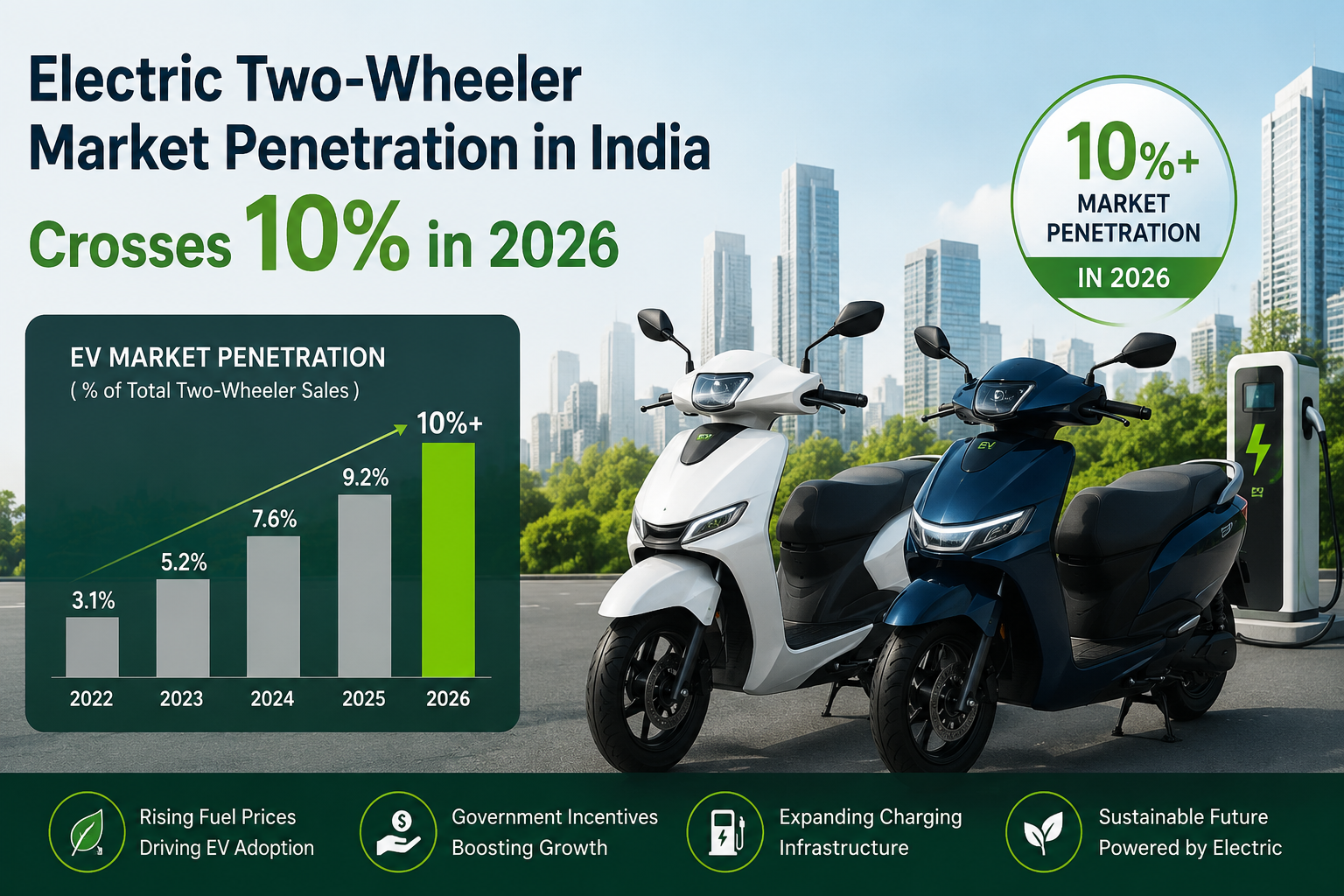
A Quiet Revolution Finally Roars
India loves its two-wheelers. Over 200 million of them buzz across its roads every day. Therefore, when electric scooters first appeared in showrooms around 2015–16, expectations ran high. However, the road from launch to mainstream was anything but smooth. Ten years later, in June 2026, electric two-wheelers have finally crossed 10% market penetration. That number may look modest. Yet it signals a genuine turning point for India’s mobility future.
Where It All Began
India’s modern electric two-wheeler story started with policy, not product. The government launched the FAME scheme — Faster Adoption and Manufacturing of Electric Vehicles — in 2015. This scheme gave the nascent EV sector a much-needed push. Early models, however, were basic. They used heavy lead-acid batteries with short ranges. Furthermore, they were often assembled from imported Chinese components.
The first truly ground-up Indian electric scooter — the Ather 340 — was unveiled in 2016. Its commercial launch only arrived in 2018. As a result, the early years were full of promise but short on delivery.
Sales were also tiny. Electric two-wheelers stood at just around 152,000 units in FY2020. In short, the market was still searching for its identity.
The Bumpy Middle Years
Between 2019 and 2022, the market picked up speed. The FAME II scheme, launched in 2019, offered subsidies for one million electric two-wheelers. Consequently, dozens of new brands entered the space. Moreover, established giants like TVS, Bajaj, and Hero MotoCorp joined the fray.
However, this growth came with problems. Several startups misused FAME subsidies. Regulatory crackdowns followed. Supply chains broke during the pandemic. Additionally, a shortage of rare earth magnets hurt production in 2025. Nevertheless, the market kept moving forward.
By FY2023, sales reached 7.3 lakh units. That figure was a 3x jump from FY2022’s 2.5 lakh units. Clearly, something had changed in buyer sentiment.
The Numbers That Tell the Story
The progress, when viewed decade-long, is impressive. Consider these key figures:
- FY2020: Around 1.52 lakh units sold
- FY2023: 7.3 lakh units — a threefold jump in one year
- FY2025: 11.5 lakh units sold
- FY2026: A record 14 lakh units delivered to customers
- June 2026: Market penetration crosses the 10% mark
Moreover, FY2026 saw 22% year-on-year growth even on an already large sales base. Electric two-wheelers now account for nearly 57–58% of all EV sales in India. In other words, they are the undisputed engine of India’s EV boom.
Who Is Selling and Who Is Buying
The competitive landscape has shifted sharply. Traditional two-wheeler giants now dominate the electric space. TVS Motor, Bajaj Auto, and Hero MotoCorp together controlled 61% of the electric two-wheeler market in FY2026.
Ather Energy delivered 2.39 lakh units in FY2026, up 82% year-on-year. Its family-focused Rizta scooter drove most of that growth. Meanwhile, Hero Vida surged 196% to sell 1.44 lakh units. Bajaj’s Chetak neared the 3-lakh milestone.
So who is buying? Primarily urban commuters looking to cut fuel costs. Delivery fleet operators are adopting electric scooters rapidly for last-mile logistics. Young buyers, attracted by smart features like GPS, app connectivity, and keyless start, form another large chunk.
Furthermore, first-time buyers in Tier 2 and Tier 3 cities are warming up to the idea. Rising petrol prices near ₹100 per litre have accelerated this shift.
What Made 10% Possible
Several forces converged to push the market past this milestone.
First, government policy played a huge role. FAME II, the PM E-DRIVE scheme, GST cuts from 12% to 5% on EVs, and state-level subsidies stacked up as powerful buying incentives. The PM E-DRIVE deadlines for electric two-wheelers — extended to July 2026 — gave the market a final push in early 2026. March 2026 alone set an all-time record of 2.8 lakh EV registrations across all categories.
Second, battery costs fell sharply. Lithium-ion cells have dropped to around USD 115 per kWh. Consequently, vehicle prices have come down. Today, an entry-level electric scooter starts at around ₹50,000. That price point is accessible to middle-income households across Tier 1 and Tier 2 cities.
Third, product quality improved dramatically. Modern electric scooters offer 120–160 km of real-world range. They charge in just a few hours. Features once reserved for luxury cars — like remote diagnostics, anti-theft alarms, ride-mode selection, and connected apps — come standard. In addition, fire safety has improved significantly with safer LFP battery chemistry.
Fourth, charging infrastructure expanded. India had 29,151 public charging stations by December 2025. Karnataka alone had over 6,000 stations. While gaps remain, particularly in rural areas, urban riders no longer face the “range anxiety” that held buyers back in earlier years.
Finally, brand trust grew. Early buyers had bad experiences with unreliable vehicles. But as established manufacturers raised quality standards, word spread. Customer service networks improved. As a result, hesitation turned into confidence.
Challenges That Remain
Reaching 10% took a full decade. Therefore, it is important to acknowledge the hurdles that slowed progress.
High upfront cost still discourages many buyers. Although prices have fallen, the gap between an electric scooter and a petrol equivalent remains. Battery-as-a-Service models, like the one TVS rolled out in March 2026, aim to close this gap by removing the battery cost from the sticker price.
Rural reach is limited. Most electric two-wheeler sales happen in metros and large cities. Charging infrastructure in small towns and villages is still thin. Financing options in rural areas are also limited.
Supply chain vulnerabilities remain a concern. The 2025 rare earth magnet shortage exposed how fragile the production chain can be. Domestic battery cell manufacturing, under the PLI scheme, is scaling up but is not yet sufficient.
After-sales service in smaller markets needs to improve. However, traditional players with deep dealer networks are better placed than startups were.
The Road Ahead: From 10% to 80%
India has set an ambitious target of 80% EV penetration in two- and three-wheelers by 2030. Reaching that level from 10% in just four years sounds impossible. However, industry forecasts suggest 15–20% penetration is achievable by FY2028. By 2030, 30–40% nationally is a realistic base-case scenario.
Several trends will drive this forward. First, battery costs are projected to fall further, reaching USD 80–90 per kWh by 2030. Second, domestic cell manufacturing under the ACC-PLI scheme will reduce import dependence. Third, more models at varied price points — from sub-₹50,000 entry scooters to high-performance motorcycles — will attract a wider audience.
Additionally, fleet electrification in delivery, logistics, and shared mobility will add large volumes. Quick-commerce players are already building electric delivery fleets at scale.
Furthermore, states like Delhi, Maharashtra, and Karnataka are likely to see penetration above 60% by 2030. Their aggressive EV policies and denser charging networks make this plausible.
Why This Milestone Matters Beyond the Numbers
Crossing 10% is not just a market statistic. It is a signal that the technology has been tested, the products have improved, and Indian buyers have given their verdict.
Each electric scooter on the road reduces tailpipe emissions. Collectively, 14 lakh new electric two-wheelers in one year mean significantly less CO₂, less noise, and cleaner urban air. India’s transport sector is its third-largest emitter of greenhouse gases. Therefore, decarbonising two-wheelers is critical to the country’s climate commitments.
Moreover, this shift is building a homegrown industry. India is now the world’s largest electric two-wheeler manufacturer. Exports are growing. Jobs in battery tech, electronics, and EV servicing are multiplying. In other words, the electric two-wheeler sector is not just changing how Indians travel. It is reshaping what India makes and sells to the world.
Conclusion
Ten years to reach 10% — that timeline tells the story of a market that struggled, stumbled, and ultimately succeeded. The FAME scheme gave it a start. Technology improvements gave it wings. Rising fuel costs gave it urgency. Trusted brands gave it credibility.
However, the harder journey starts now. Getting from 10% to 30%, 50%, or 80% will demand better infrastructure, lower costs, and smarter policy. The next decade will determine whether India’s electric two-wheeler revolution becomes truly universal — or remains confined to its cities.
Either way, June 2026 is a date worth remembering. It is the moment when India’s electric two-wheelers stopped being a niche and started becoming the norm.
Recent Comments