
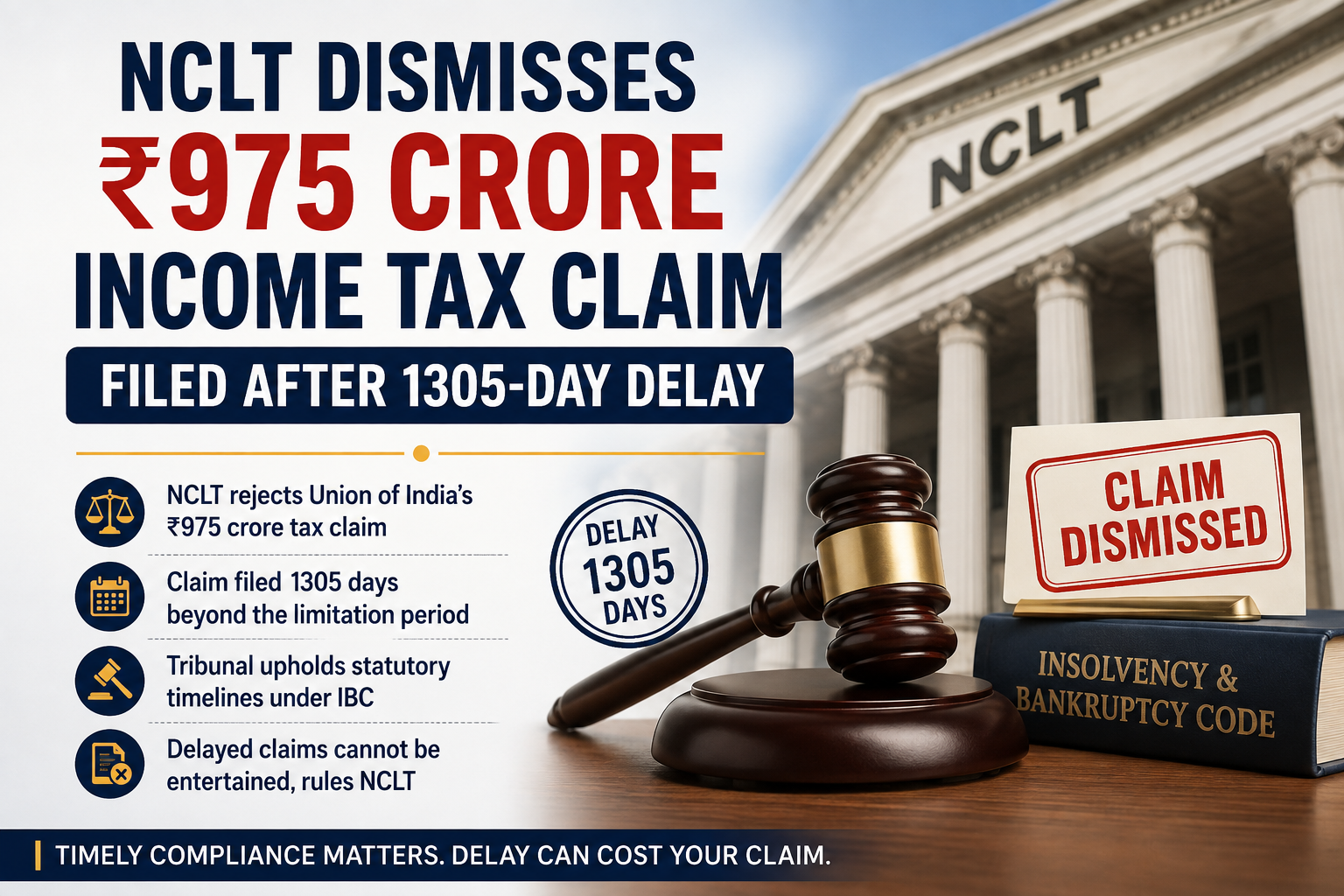
The National Company Law Tribunal (NCLT) has rejected a massive tax claim. The Chandigarh Bench refused to condone a delay of 1,305 days. As a result, the Income Tax Department’s ₹975.56 crore claim now stands dismissed.
This ruling reinforces a key principle of insolvency law. Once a resolution plan gets approved, the process must stay final. Therefore, late claims threaten the certainty that creditors rely on.
What Triggered the Dispute
The corporate insolvency resolution process (CIRP) began on 31 May 2022. However, the Income Tax Department claimed it never received notice of this process. Consequently, it only discovered the proceedings in October 2025, during a routine manual search.
The department filed its claim on 15 October 2025. By then, the resolution plan had already secured approval from the Committee of Creditors (CoC). Mukesh Gupta, the Resolution Professional (RP), rejected the claim on 7 November 2025. He cited two clear reasons: expired timelines and prior CoC approval on 25 April 2023.
Arguments From Both Sides
Counsel for the Income Tax Department raised a strong objection. They argued the RP failed his statutory duty by skipping proper notification. After all, the outstanding dues appeared clearly in the debtor’s own accounts.
The department also leaned on Supreme Court precedent. It cited landmark rulings like Rainbow Papers and Essar Steel. These cases establish that authorities cannot simply ignore statutory dues.
Meanwhile, the RP held a firmer position. He stressed that the claim arrived 1,305 days late. Additionally, the resolution plan had already won approval, backed by a 93.48% creditor voting share. Admitting such a stale claim, he argued, would disrupt the CoC’s commercial judgment.
How the Tribunal Ruled
The bench included Judicial Member Khetrabasi Biswal and Technical Member Shishir Agarwal. Both members agreed that insolvency law demands strict timeline compliance. Moreover, they found no evidence of due diligence from the department across three years.
The tribunal’s reasoning centered on one core issue: certainty. Reopening a settled resolution plan, the bench noted, would undermine the entire insolvency framework. Finality matters most once creditors have already voted and moved forward.
Ultimately, the NCLT dismissed the department’s application entirely. The order stated that no sufficient cause existed for condoning the delay. It also found no grounds to direct admission of the claim.
Why This Ruling Matters
This case sends a clear signal to government departments. Tax authorities must monitor insolvency proceedings actively, not passively. Waiting years to act on dues carries real financial consequences.
Similarly, other tribunals have echoed this stance recently. NCLT Bengaluru, for instance, refused a 1,784-day delayed claim in the Falcon Tyres liquidation case. That pattern suggests tribunals nationwide are prioritizing IBC timelines over late-filed government claims.
For companies undergoing insolvency, this ruling offers reassurance. Approved resolution plans deserve protection from future disruption. Otherwise, investors and creditors could never trust the process.
Key Takeaways
- NCLT Chandigarh dismissed a ₹975.56 crore tax claim.
- The Income Tax Department filed the claim 1,305 days late.
- The tribunal upheld the resolution plan’s finality.
- This decision aligns with a broader trend across NCLT benches.
Case Citation: Commissioner of Income Tax vs Mukesh Gupta, 2026 TAXSCAN (NCLT) 232, IA(IBC) No. 97/2026, dated 10 July 2026.
Recent Comments