
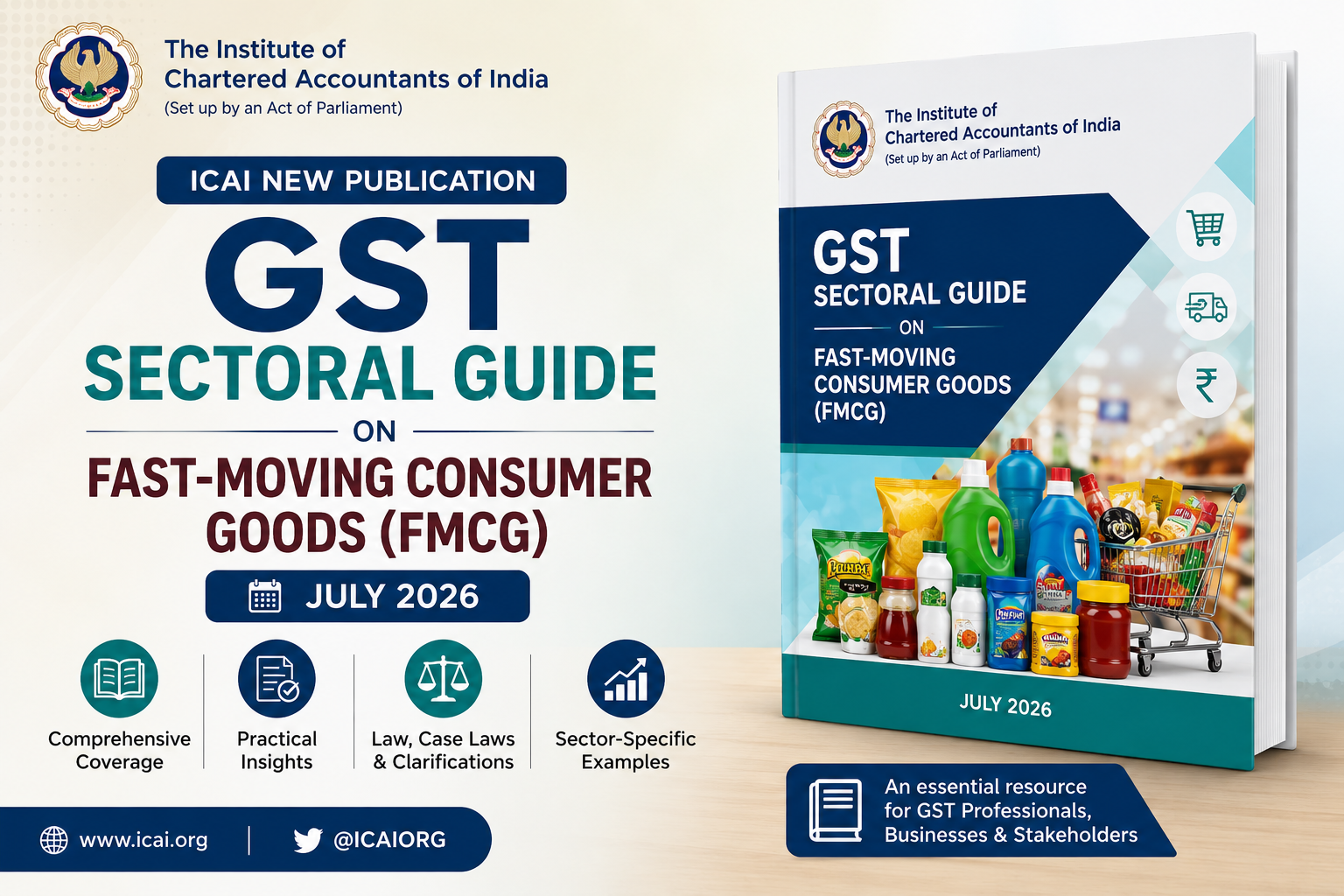
The Institute of Chartered Accountants of India recently released a fresh, sector-focused resource. <cite index=”17-1″>This GST Sectoral Guide addresses Fast-Moving Consumer Goods, or FMCG, businesses specifically, and it also reflects amendments introduced by the Finance Act, 2026.</cite> Consequently, professionals now gain a dedicated reference for this fast-paced industry.
Second Publication in a Growing Series
This guide does not stand alone. <cite index=”17-1″>It represents the second release under ICAI’s Industry-Specific GST Publication Series.</cite> Therefore, ICAI signals a clear commitment toward sector-wise tax guidance going forward.
<cite index=”17-1″>The FMCG sector itself spans daily-use products, including packaged food, beverages, personal care items, and household goods.</cite> Naturally, this breadth makes GST compliance genuinely complex for businesses involved.
What the Guide Actually Covers
The publication follows a structured, four-chapter format. <cite index=”19-1″>The first chapter introduces the FMCG industry, explains different business models, and outlines how GST applies across the sector.</cite>
The second chapter then shifts toward practical compliance matters. <cite index=”19-1″>It explains relevant laws, notifications, exemptions, and the compliance requirements that FMCG businesses must follow.</cite> Meanwhile, several tricky, industry-specific scenarios also receive dedicated attention.
<cite index=”17-1″>Specifically, the handbook discusses GST treatment for expired, damaged, and written-off goods.</cite> Additionally, it addresses <cite index=”17-1″>post-sale discounts, related-party transactions, supplies between different registrations of the same company, and Input Service Distributor provisions.</cite> These topics frequently trouble FMCG accountants during routine assessments.
Litigation Trends and Judicial Insights
Tax disputes rarely disappear on their own. Fortunately, this guide tackles that reality directly. <cite index=”19-1″>The third chapter covers important court decisions, advance rulings, and recent litigation trends within the FMCG industry.</cite>
This section carries real practical value. <cite index=”19-1″>It helps businesses understand how authorities interpret and apply GST provisions in actual practice.</cite> As a result, professionals can anticipate disputes before they escalate further.
Addressing Real Industry Challenges
Beyond legal theory, the guide stays grounded in practice. <cite index=”19-1″>The fourth chapter highlights major GST issues currently facing the FMCG industry.</cite> Furthermore, <cite index=”19-1″>it examines practical compliance challenges, legal ambiguities, and possible suggestions for resolving them efficiently.</cite>
This forward-looking approach distinguishes the guide from purely academic texts. Instead, it offers actionable insight for everyday professional use.
Who Authored This Resource
Expertise clearly shaped this publication’s development. <cite index=”17-1″>CA Kunal Jain authored the handbook, while CA Thirumalai Sampath and CA Gaurav Kenkre reviewed the content.</cite> This collaborative process strengthens the guide’s overall accuracy and relevance.
Why This Guide Matters
FMCG businesses operate under constant pricing and margin pressure. Therefore, GST missteps can prove costly rather quickly. This guide reduces that risk substantially.
<cite index=”19-1″>The publication serves as a useful resource for chartered accountants, tax professionals, and others working within the FMCG sector.</cite> Ultimately, it helps them apply GST provisions more confidently and correctly.
Conclusion
ICAI continues strengthening its sector-specific GST guidance through this latest release. Professionals handling FMCG accounts should certainly review this handbook closely. Doing so will sharpen compliance accuracy and reduce future litigation risk.
Recent Comments