
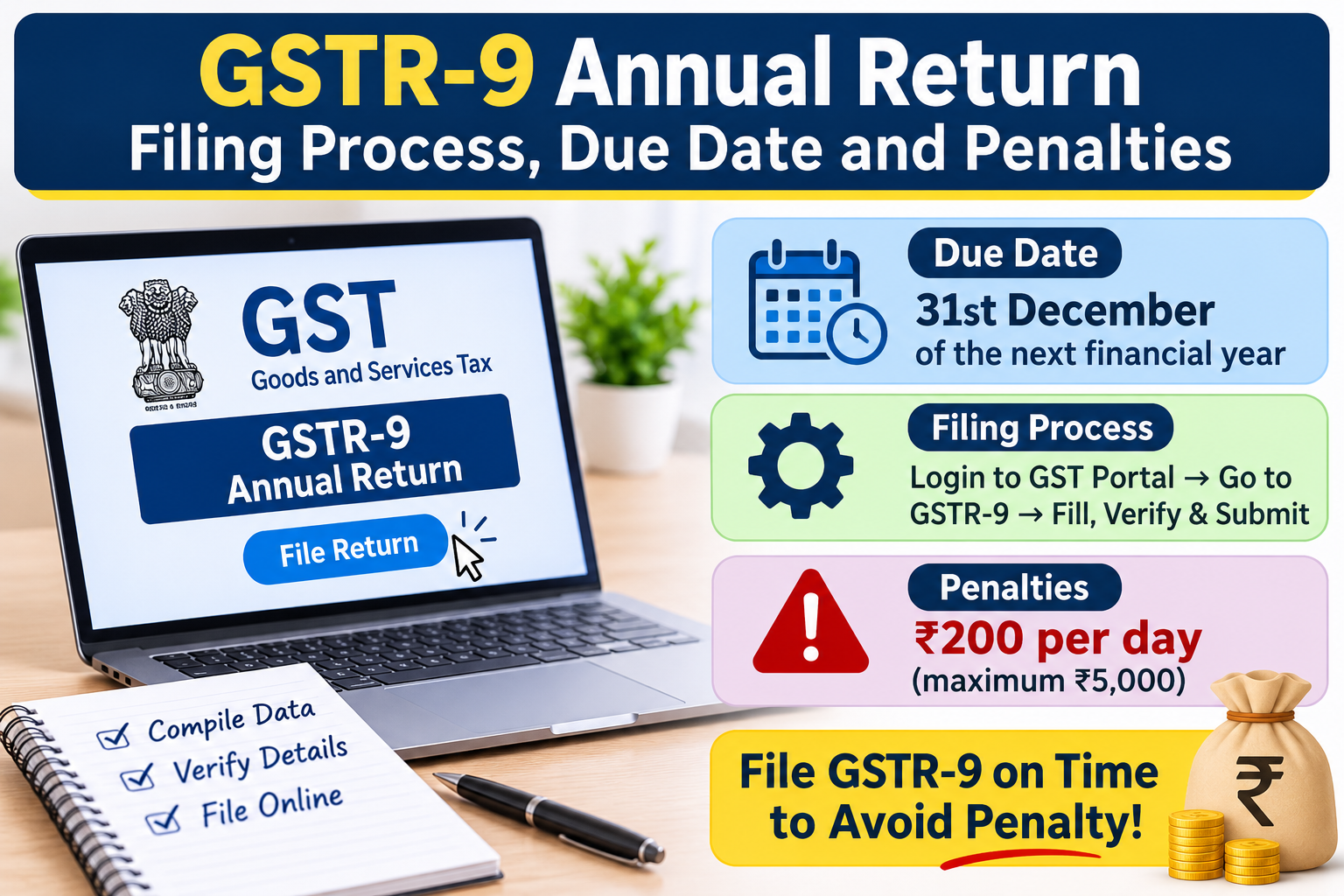
The GSTR-9 annual return summarises a business’s yearly GST activity in one form. Many taxpayers treat it as a routine task. However, mistakes in this return can trigger notices, late fees, and interest. This guide explains who must file, when to file, and what happens if you miss the deadline. Moreover, it covers the practical steps that keep your filing accurate.
What Is the GSTR-9 Annual Return?
GSTR-9 is a consolidated return for regular GST taxpayers. It reports outward supplies, input tax credit (ITC), tax paid, and adjustments made during the financial year. In other words, it brings your monthly or quarterly returns together in one place.
The form has several parts and many tables. It captures details from GSTR-1, GSTR-3B, and your purchase records. Therefore, the figures must match your earlier filings. Any gap between them can raise questions from the tax department.
Who Must File GSTR-9?
Filing is mandatory for regular taxpayers with aggregate turnover above ₹2 crore. Taxpayers below that limit may file voluntarily. Even so, a voluntary filing helps maintain clean records.
Taxpayers above ₹5 crore also need a second form. This form is the GSTR-9C reconciliation statement. Businesses above that limit must file it along with the annual return.
Some taxpayers do not file GSTR-9 at all. Input service distributors, casual taxable persons, and non-resident taxable persons are common examples. Similarly, persons paying TDS or collecting TCS follow separate rules.
GSTR-9 Due Date for FY 2025-26
The due date is 31 December following the financial year. Consequently, the return for FY 2025-26 is due on 31 December 2026. That leaves only a few weeks from today.
The government sometimes extends this deadline. However, you should not rely on an extension. The last three annual returns carried no extension. Instead, plan to file before the due date.
Another date matters just as much. The last day to claim unclaimed ITC for FY 2025-26 is 30 November 2026. After that, you cannot claim the credit. So, review your ITC position this month.
What Is New for FY 2025-26?
This year’s return is more complex than usual. The financial year contains two GST rate structures, because the 12% and 28% slabs ended on 22 September 2025. As a result, you must report supplies under both rate systems.
The form also changes how credit details appear. Table 8A now auto-fills from GSTR-2B instead of GSTR-2A. Therefore, compare the auto-filled values with your books. Differences are common, particularly for late-reported supplier invoices.
Additionally, the GST Network may amend the form before the utility opens. Always check the portal for the latest layout.
Documents to Gather Before Filing
Preparation saves time and prevents errors. Collect the following items first:
- Filed GSTR-1 and GSTR-3B returns for all twelve months
- GSTR-2B statements for the year
- Sales and purchase registers
- HSN-wise and rate-wise summaries
- Audited financial statements, where applicable
- A valid digital signature certificate (DSC) or EVC access
Next, reconcile your books with your returns. Start with turnover, then move to ITC and tax paid. Fix any mismatch through your next available return where the law permits.
Step-by-Step GSTR-9 Filing Process
The process is simple once your data is ready. Follow these steps on the GST portal:
- Log in and open the Returns Dashboard.
- Select the financial year and choose GSTR-9.
- Choose whether you want to file the return now.
- Review the auto-populated tables carefully.
- Fill in or correct the remaining details.
- Preview the draft as a PDF or Excel file.
- Compute and pay any late fee or additional liability.
- Submit the form and sign it with DSC or EVC.
Take extra care at the final step. A GSTR-9 cannot be revised once filed. Hence, verify every figure before you click submit.
Understanding GSTR-9C
GSTR-9C is a reconciliation statement. It compares your annual return with your audited financial statements. Furthermore, it explains any difference in turnover, tax, or ITC.
The form is now self-certified. The separate auditor certification was removed from FY 2020-21 onwards. Nevertheless, your records must still be accurate and well documented.
Do not treat GSTR-9C as an afterthought. Under CBIC Circular 246/03/2025-GST, late fee applies to the whole annual return, including GSTR-9C. Consequently, forgetting this form can raise your late fee.
GSTR-9 Late Fee: What You Will Pay
Late fee depends on your aggregate turnover. The rate is ₹50 per day up to ₹5 crore, ₹100 per day from ₹5 to ₹20 crore, and ₹200 per day above ₹20 crore. The amount splits equally between CGST and SGST.
The law also sets a cap on the total fee. For larger taxpayers, the cap is 0.25% of turnover in the state or union territory under each Act. Smaller slabs have lower caps. For instance, the cap for taxpayers up to ₹5 crore is 0.04% of turnover.
Here is a quick example. Suppose a business with ₹10 crore turnover files 30 days late. The fee would be ₹100 multiplied by 30 days. That equals ₹3,000, split between CGST and SGST.
Note that online sources describe the caps slightly differently. Therefore, confirm the exact slab and cap in the latest government notification before you pay.
Interest and Other Penalties
Late fees are only one part of the cost. Interest applies when you under-report or delay tax payment. Interest runs from the due date of payment until the actual date of payment. The standard rate under Section 50 is 18% per year on the unpaid tax.
Beyond that, non-filing can invite further action. It may lead to scrutiny or notices from the GST department. Mismatches between GSTR-1 and GSTR-3B are a frequent trigger. Moreover, wrongly claimed ITC may bring demand notices and penalties under the CGST Act.
Can You File After the Due Date?
Yes, you can. From January 2026, the return can be filed after 31 December, subject to late fees. However, you must pay the late fee before submission.
There is also a firm outer limit. Once a return is more than three years past its due date, the portal locks it. Therefore, never leave an old return pending.
Common Mistakes to Avoid
Most errors are easy to prevent. Watch out for these frequent problems:
- Reporting figures that differ from GSTR-1 or GSTR-3B
- Claiming ITC that does not appear in GSTR-2B
- Ignoring the 30 November ITC deadline
- Mixing up old and new GST rates
- Skipping GSTR-9C when turnover exceeds ₹5 crore
- Filing in a hurry on the last day
Additionally, the portal can slow down near the deadline. So, file a week early to leave room for technical issues.
Practical Tips for a Smooth Filing
Start the reconciliation now instead of in December. Review your ITC first, because that deadline arrives sooner. Then, match your sales data with filed returns.
Keep working papers for every adjustment. These notes help if an officer asks questions later. Finally, consider a professional review if your turnover is large or your data is complex.
Conclusion
The GSTR-9 annual return closes your GST year, and accuracy matters more than speed. The due date for FY 2025-26 is 31 December 2026. Meanwhile, the ITC cut-off on 30 November comes even earlier.
Late fees, interest, and notices are all avoidable. Reconcile early, verify carefully, and file before the deadline. As a result, you will protect both your credit and your compliance record.
This article is for general information. So please verify rates, caps, and dates on the GST portal or with a qualified professional before filing.
Recent Comments