
Introduction: What Is Input Tax Credit?
Input Tax Credit (ITC) is a powerful feature of the GST system. It allows businesses to reduce their tax liability. Essentially, you pay tax on purchases and claim it back against output tax.
However, not every purchase qualifies for ITC. The government specifically blocks certain credits. These are called Blocked ITC under Section 17(5) of the CGST Act, 2017.
Understanding blocked ITC is crucial for every GST-registered taxpayer. Otherwise, you risk wrong claims, penalties, and audit issues.
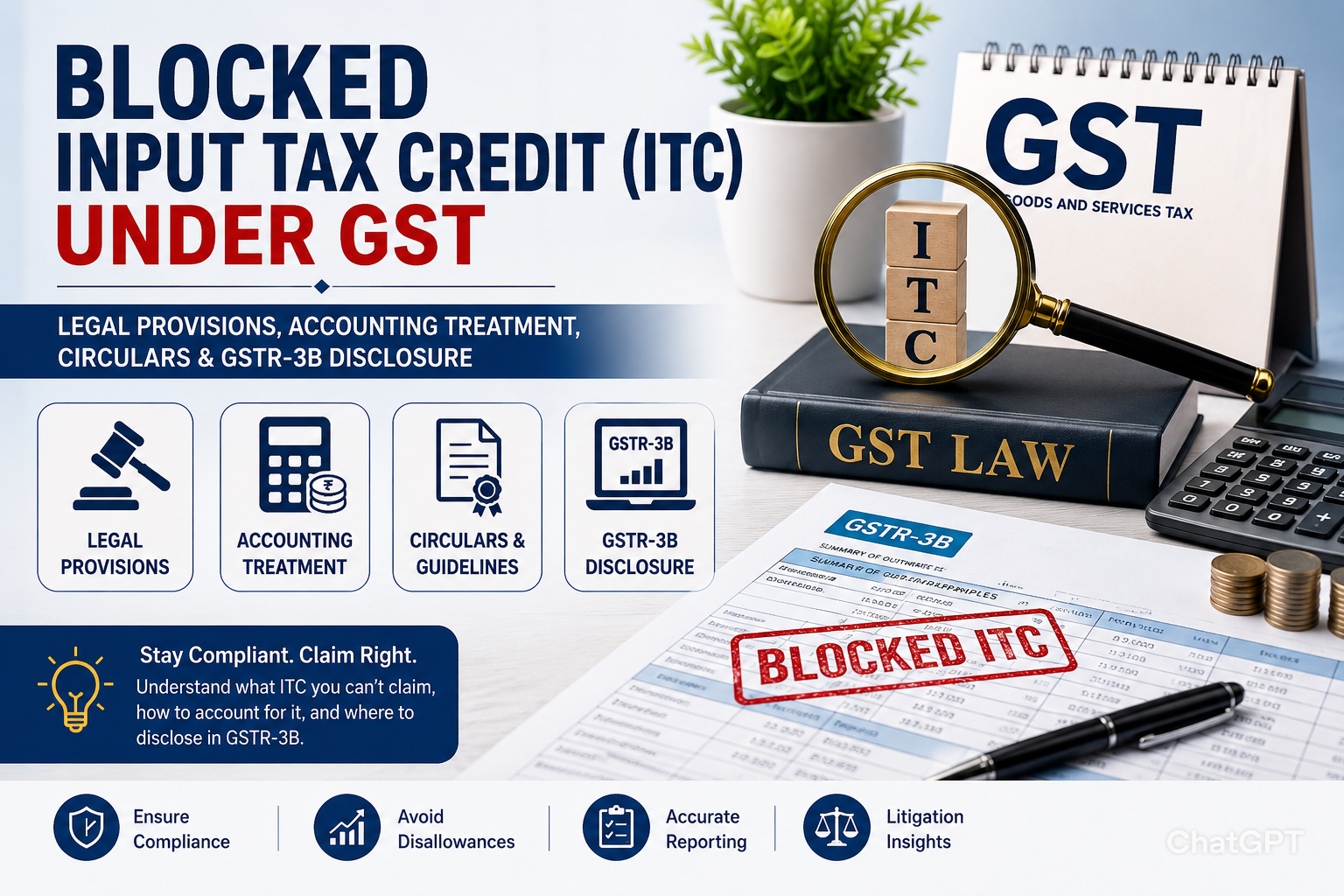
What Is Blocked ITC? A Simple Definition
Blocked ITC refers to input tax credit that a taxpayer cannot claim, even if they have a valid tax invoice. The law specifically denies these credits.
Therefore, even if you pay GST on certain expenses, you cannot reduce your tax liability using that amount. This is a hard restriction under the law.
Legal Basis: Section 17(5) of the CGST Act, 2017
The entire framework of blocked ITC rests on Section 17(5) of the Central Goods and Services Tax (CGST) Act, 2017. This section lists specific goods and services where ITC is not available.
Additionally, Section 16 lays down the general conditions for claiming ITC. Section 17(5) creates exceptions to those general rules. Always read both sections together.
The key principle here is simple: if a purchase falls under Section 17(5), no ITC is allowed, regardless of the business purpose.
Categories of Blocked ITC Under Section 17(5)
Let us now examine each category clearly and simply.
1. Motor Vehicles and Other Conveyances
ITC on motor vehicles is generally blocked. However, there are important exceptions.
ITC is blocked for:
- Motor vehicles used for personal or employee transportation
- Vehicles with a seating capacity of up to 13 persons (including the driver)
ITC is allowed for:
- Vehicles used for supply of other vehicles (dealers)
- Vehicles used for transportation of goods
- Vehicles used for imparting driving training
- Vehicles used for transport services (e.g., taxi operators)
Therefore, a company buying a car for employee cab service can still claim ITC. On the other hand, a general office car purchase attracts the block.
2. Food, Beverages, and Outdoor Catering
ITC on food and beverages is blocked. This covers restaurant bills, corporate meals, and pantry items.
Furthermore, outdoor catering for employees or events also falls under this block. Similarly, health services, cosmetic surgery, and beauty treatments are blocked.
Exception: If the business itself supplies food or beverages as a core service, ITC is available. For instance, a restaurant or a hospitality company can claim it.
3. Club Memberships and Health Club Fees
Memberships to clubs, health centers, and fitness facilities are blocked. Consequently, company-paid gym memberships or golf club fees do not qualify for ITC.
4. Life Insurance and Health Insurance
ITC on life insurance premiums is blocked. Similarly, health insurance for employees is also blocked under Section 17(5).
Exception: If the employer is legally obligated to provide health insurance (under any law), ITC is available. For example, insurance under the Employees’ Compensation Act qualifies.
5. Travel Benefits for Employees
Travel benefits given to employees are blocked. This includes leave travel concession (LTC) and home travel concession (HTC).
Additionally, employee relocation expenses and personal travel bookings for employees are blocked.
6. Works Contract Services for Immovable Property
ITC on works contract services for construction of immovable property is blocked. This covers construction, renovation, or repair of buildings, roads, and similar structures.
However, plant and machinery are specifically excluded from this block. Therefore, ITC is available for works contracts related to plant and machinery.
7. Goods or Services for Personal Consumption
Any goods or services used for personal purposes are blocked. If an expense benefits an individual rather than the business, ITC is unavailable.
For instance, goods purchased for the proprietor’s personal use clearly attract the block.
8. Composition Taxpayers
Goods or services received by a composition dealer are blocked. Composition dealers operate under a simplified tax scheme. Consequently, they do not get to claim any ITC.
9. Goods Lost, Stolen, Destroyed, or Written Off
ITC is blocked for goods that are:
- Lost or stolen
- Destroyed or damaged
- Written off or given as free gifts or samples
Therefore, if your stock is destroyed in a fire, you must reverse the ITC already claimed.
Key Amendment: Budget 2021 and Further Clarifications
The Finance Act, 2021 made significant changes to Section 17(5). Specifically, it expanded the scope of blocked ITC on construction-related expenses.
As a result, the ITC block now covers all expenses related to construction of any immovable property on one’s own account. This includes expenses incurred by taxpayers for self-construction, even using their own employees.
Furthermore, the amendment clarified that plant and machinery do not include civil structures or general office buildings.
CBIC Circulars and Important Clarifications
The Central Board of Indirect Taxes and Customs (CBIC) has issued several important circulars. These help resolve practical disputes around blocked ITC.
Circular No. 172/04/2022-GST
This circular addressed ITC on CSR (Corporate Social Responsibility) activities. According to the CBIC, CSR expenses are not mandatory for business operations. Therefore, ITC on goods and services used for CSR activities is blocked.
Circular No. 92/11/2019-GST
This circular clarified the treatment of ITC on employee insurance. Specifically, it stated that group health insurance is blocked unless mandated by law.
AAR and AAAR Rulings
Moreover, various Authority for Advance Rulings (AAR) decisions have shaped the interpretation. For example, rulings on canteen services and employee transportation have been particularly impactful.
Notably, many AARs held that canteen facilities provided under the Factories Act qualify for ITC. This is because the obligation is imposed by law, creating an exception to the block.
Accounting Treatment of Blocked ITC
Accounting for blocked ITC requires careful attention. Incorrect treatment leads to reporting errors.
Step 1: Identify the Blocked Expense
First, identify whether the purchase falls under Section 17(5). Use the list above as a checklist.
Step 2: Do Not Debit the GST Ledger
For blocked ITC, do not pass a credit entry in the ITC ledger. Instead, treat the full invoice amount (including GST) as a cost.
Journal Entry — Blocked ITC (e.g., Employee Car Purchase):
Motor Vehicle A/c         Dr.  ₹10,00,000
GST (Blocked — Expensed)  Dr.  ₹1,80,000
    To Bank / Creditors A/c     Cr.  ₹11,80,000
Here, the GST of ₹1,80,000 is debited to the asset or expense account. It is not reflected as ITC receivable.
Step 3: Segregation in Books
Additionally, it is good practice to maintain a separate ledger for blocked ITC. This helps during audits and reconciliation.
Many businesses use a ledger named “GST Blocked ITC Expense” or include it within the respective expense head.
Step 4: Reversal of Wrongly Claimed ITC
If ITC is wrongly claimed, it must be reversed. Pass the following entry:
ITC Reversal A/c          Dr.  ₹XXXXX
    To Electronic Credit Ledger    Cr.  ₹XXXXX
Furthermore, interest at 18% per annum applies from the date of wrong claim to the date of reversal.
GSTR-3B Disclosure of Blocked ITC
GSTR-3B is the monthly return where taxpayers declare their ITC. Blocked ITC has a specific disclosure row in this return.
Where to Disclose?
In Table 4 of GSTR-3B, there are specific rows for ITC details:
| Row | Description |
|---|---|
| 4(A) | Eligible ITC (to be claimed) |
| 4(B)(1) | ITC reversed — Rule 42 & 43 |
| 4(B)(2) | Other reversals |
| 4(D)(1) | Ineligible ITC — Section 17(5) |
| 4(D)(2) | Ineligible ITC — Others |
Therefore, Row 4(D)(1) is specifically meant for blocked ITC under Section 17(5).
What Must You Do?
First, you must not include blocked ITC in the eligible ITC columns. Second, report it separately in Row 4(D)(1). Consequently, the system will not allow this amount to be used against output tax liability.
Common Mistake to Avoid
Many taxpayers accidentally include blocked ITC in Row 4(A) (eligible ITC). This is a serious error. Subsequently, it attracts scrutiny, demand notices, and interest liability.
Always reconcile your purchase register with the blocked categories before filing GSTR-3B.
Impact of Rule 42 and Rule 43: Proportionate Reversal
Sometimes, a taxpayer uses goods or services for both taxable and exempt supplies. In such cases, ITC must be reversed proportionately.
Rule 42 covers input goods and input services. Rule 43 covers capital goods. Together, they govern proportionate reversal of ITC.
Additionally, if some inputs relate to blocked categories, those must be excluded first. Thereafter, the remaining ITC is subjected to Rule 42/43 proportionate calculation.
Practical Examples of Blocked ITC
Let us look at some real-world situations.
Example 1: Office Renovation
A company spends ₹50 lakh on renovating its office building. GST paid is ₹9 lakh.
Here, the renovation is for an immovable property. Therefore, the entire ₹9 lakh GST is blocked under Section 17(5)(c) and (d).
Example 2: Employee Health Insurance
A company pays health insurance premium of ₹5 lakh for employees. GST of ₹90,000 applies.
Unless the policy is mandated by law (e.g., a factory under the Factories Act), the ITC of ₹90,000 is blocked. Consequently, it is added to the insurance expense.
Example 3: Company Car Purchase
A manufacturing firm buys a car for the MD. The invoice includes ₹2.88 lakh GST.
Since this is a personal-use vehicle with fewer than 13 seats, the ITC is blocked. Furthermore, the GST gets capitalized as part of the car’s cost.
Example 4: Restaurant Providing Catering
A hotel provides catering services. It purchases food supplies and pays GST.
In this case, the hotel is in the business of supplying food. Therefore, the ITC block does not apply. The hotel can validly claim ITC on food purchases.
GST Audit and Scrutiny Perspective
Tax officers closely examine blocked ITC during audits. Specifically, they check whether businesses wrongly claimed ITC on personal or blocked expenses.
Moreover, the Annual Return (GSTR-9) and the GSTR-9C reconciliation statement require disclosure of ineligible ITC. Therefore, any mismatch between GSTR-3B and GSTR-9 triggers further queries.
To avoid problems, always maintain supporting documentation. These include invoices, purpose of purchase notes, and business necessity records.
Checklist for Businesses
Use this simple checklist to manage blocked ITC effectively:
- Identify all purchases under Section 17(5) categories
- Do not claim GST on such purchases as ITC
- Capitalize or expense the full invoice amount (including GST)
- Disclose correctly in GSTR-3B Row 4(D)(1)
- Reconcile GSTR-3B with purchase register monthly
- Reverse wrongly claimed ITC promptly with interest
- Maintain separate blocked ITC ledger for audit readiness
- Review legal obligation exceptions (insurance, canteen, etc.)
Conclusion: Stay Compliant, Stay Safe
Blocked ITC is one of the most misunderstood areas of GST. Nevertheless, it is also one of the most scrutinized. Understanding Section 17(5) thoroughly protects your business from demand notices and penalties.
Additionally, proper accounting and timely GSTR-3B disclosures ensure clean compliance. As CBIC continues to issue clarifications, staying updated with circulars is equally important.
In summary, the key is to segregate eligible ITC from blocked ITC at the invoice-booking stage itself. This simple discipline saves significant compliance headaches later.
Recent Comments