
India’s manufacturing sector is undergoing a remarkable transformation. Haryana, a state known for its industrial strength, is leading this change boldly. The Haryana government has unveiled its ambitious “Make in Haryana” Industrial Policy, targeting ₹5 lakh crore in investments and 10 lakh new jobs.
Furthermore, as part of this sweeping reform, the state introduced a dedicated sectoral policy. Chief Minister Nayab Singh Saini launched the policy alongside nine new sector-specific policies, including toys and sports equipment.
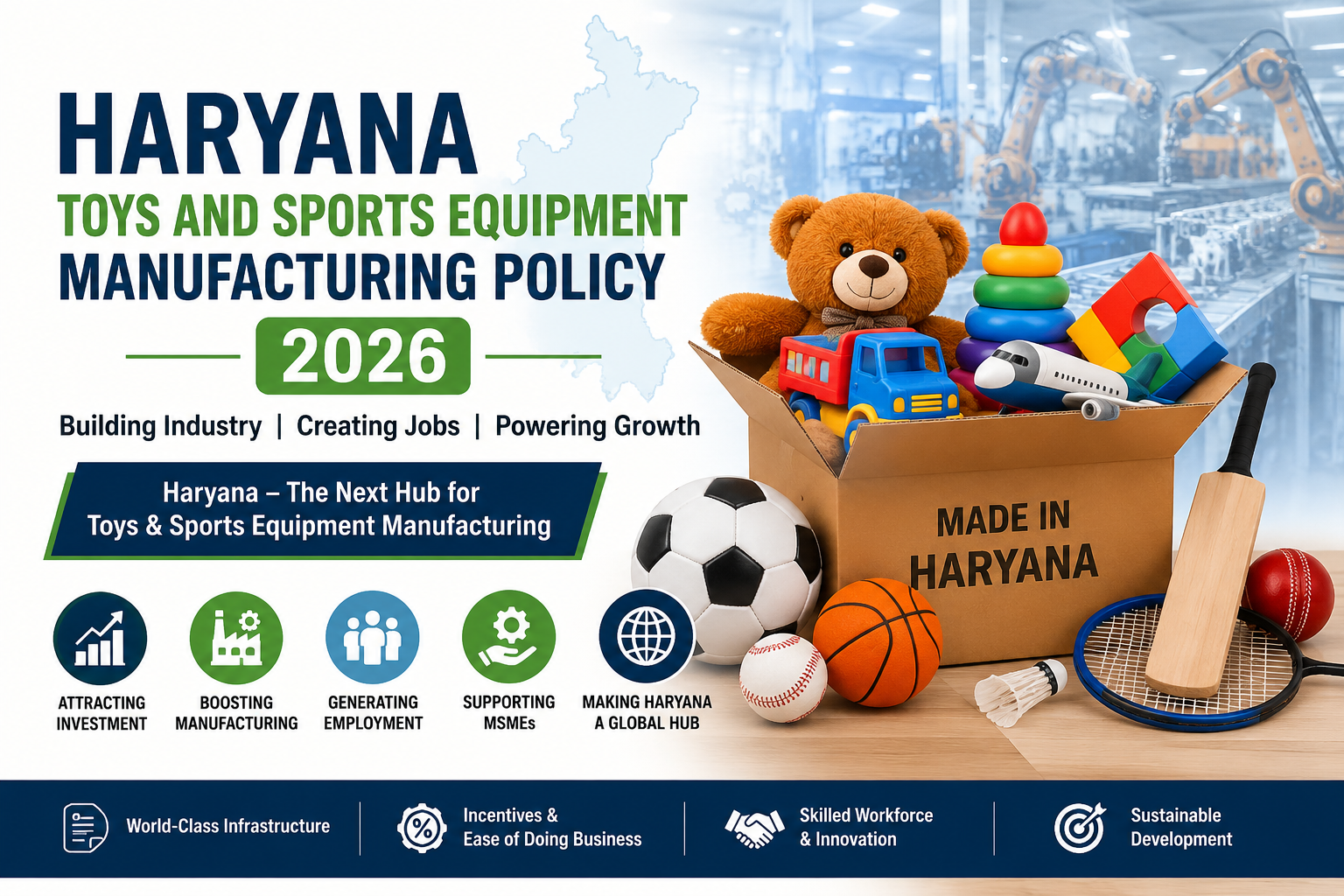
The Haryana Toys and Sports Equipment Manufacturing Policy 2026 is a focused, forward-looking document. It aims to make Haryana a top destination for toy and sports gear makers. This article breaks down the policy in simple, clear terms.
What Is This Policy?
The Haryana Toys and Sports Equipment Manufacturing Policy 2026 is a government initiative. It specifically targets the toys and sports goods sector in the state. The Haryana Industries and Commerce Department notified this policy alongside six other sector-specific policies, all effective for five years.
Additionally, this policy is part of a much larger economic vision. The Make in Haryana Industrial Policy 2026 replaces the Haryana Enterprises and Employment Policy 2020, focusing on attracting investment, generating jobs, and doubling merchandise exports.
Therefore, the toys and sports policy sits within a strong, well-funded framework. Businesses entering this sector will benefit from the broader industrial ecosystem Haryana is building.
Why Toys and Sports Equipment?
Many people may wonder why Haryana chose this specific sector. The answer lies in India’s growing consumer market and export potential.
The electronics toys industry has witnessed significant growth in recent years, offering interactive, educational, and entertaining products for children and adults alike.
Moreover, sports equipment demand is rising steadily in India and globally. Physical fitness awareness is growing rapidly among Indian consumers. Consequently, both toys and sports gear represent high-growth opportunities for manufacturers.
India currently imports a large share of its toys from China. Therefore, domestic production is both a national priority and a business opportunity.
The Dedicated Toy Industry Cluster
One of the most exciting features of this policy is the planned industrial cluster. Chief Minister Nayab Singh Saini said the state will build a dedicated toy industry cluster covering 250 to 350 acres.
This cluster will offer manufacturers everything they need in one place. Infrastructure, logistics, common facilities, and regulatory support will all be centrally available.
The state aims to build this toy industry cluster on a 250- to 350-acre site, and officials said it would help diversify industry while strengthening India’s economy through boosted exports.
In addition, clustering manufacturers together reduces costs and increases efficiency. Shared resources lower the investment burden for individual companies. As a result, even small and mid-sized businesses can compete effectively.
Key Objectives of the Policy
The policy aims to strengthen Haryana’s position as a leading investment destination by making production factors more cost-competitive, reducing regulatory burdens, promoting innovation, and supporting sustainable industrial growth.
Specifically, for the toys and sports sector, the objectives include:
Attracting investment from both domestic and global manufacturers into Haryana.
Creating employment for thousands of young workers across the state.
Boosting exports so that Haryana-made toys and sports goods reach international markets.
Promoting innovation through research, design, and new product development support.
Ensuring quality by encouraging manufacturers to meet global safety and product standards.
Financial Incentives for Manufacturers
The policy offers a rich package of financial benefits. These incentives make setting up a business in Haryana financially attractive. Key incentive lines include a capital subsidy of up to 30%, net state GST reimbursement, and R&D support of up to ₹50 crore.
Furthermore, the government goes beyond basic subsidies. The state will also offer a 50% top-up on incentives received under central PLI (Production Linked Incentive) schemes.
This means manufacturers in the toys and sports sector can combine state and central incentives. Together, these benefits significantly reduce the cost of starting or expanding operations.
Employment Subsidies and Workforce Development
Job creation is a central goal of this policy. Haryana wants local youth to fill positions in new factories and facilities.
The state offers robust employment subsidies of up to ₹1 lakh per employee annually for companies hiring youth registered on the Haryana Kaushal Rozgar Nigam portal.
Moreover, several companies have already shown interest in working with training institutes. Several firms showed interest in adopting Industrial Training Institutes, which could help supply a skilled workforce that matches industry needs and supports planned investments.
As a result, the policy creates a cycle of benefit. Manufacturers get skilled workers. Workers get steady employment. The state’s economy grows steadily in return.
Green and Sustainable Manufacturing
The policy strongly encourages eco-friendly production practices. Haryana recognises that modern manufacturing must be environmentally responsible. Sustainability subsidies cover renewable energy adoption, zero liquid discharge systems, and carbon credit generation.
Additionally, the government offers special support for companies facing global market disruptions. Export-oriented units hit by geopolitical disruptions are eligible for one-time export diversification support.
Therefore, toy and sports equipment makers can grow without sacrificing environmental responsibility. Green practices are not just encouraged; they are financially rewarded.
AI-Enabled Single Window System
Starting a business in any state involves navigating complex government processes. Haryana has solved this with technology. The AI Single Window 2.0, officially called the Intelligent Investment Facilitation Portal, bundles approvals, land allocation, incentives, and clearances on a single interface.
Consequently, investors no longer need to visit multiple departments. Everything is available on one digital platform. This dramatically reduces time and effort for new businesses.
The portal features a smart AI agent for real-time assistance, an AI-powered investment blueprint generator, and a GIS-based land identification system.
As a result, setting up a toy or sports equipment factory in Haryana has become easier than ever before.
Simplified Incentive Framework
Earlier, Haryana used a complicated district classification system. That system often confused investors. The policy scraps the older A-B-C-D block classification system in favour of a simplified statewide incentive framework.
Now, fiscal incentives are tied to five clear performance metrics. The industrial policy offers incentives for intra-state sales, fast-track commencement of operations, local employment generation, R&D infrastructure creation, and export turnover and green initiatives.
Therefore, manufacturers know exactly what they need to do to earn benefits. The system is transparent, fair, and easy to understand.
Export Vision and Global Reach
Haryana is not only thinking locally. The state wants its products to reach buyers across the world. The Make in Haryana policy aims to increase annual merchandise exports from ₹1.62 lakh crore in FY25 to ₹3.24 lakh crore by the end of the policy term.
For toy and sports equipment exporters, this is a powerful signal. The state will actively support companies trying to enter foreign markets.
Representatives raised steps to manage export hurdles and recommended creating global warehouses abroad for product storage by companies.
Moreover, Haryana’s geography gives it a natural advantage. The state’s expressway network, freight corridors, logistics hubs, and proximity to the National Capital Region have established it as one of India’s most strategic investment destinations.
Haryana’s Industrial Strengths
Haryana has an impressive industrial track record. This background makes it well-suited for the toys and sports sector. Haryana currently contributes 3.6% to India’s national GDP despite accounting for only 1.3% of the country’s geographical area.
Furthermore, the state’s infrastructure is already strong. Roads, power supply, water, and connectivity are all in place. New manufacturers can, therefore, start production quickly without building from scratch.
The state also has a large pool of trained and trainable workers. Additionally, its proximity to Delhi gives easy access to national and international trade networks.
Alignment With National Goals
This policy does not exist in isolation. It connects directly with central government priorities.
The government of Haryana endeavors to create a favorable ecosystem, offer financial, regulatory, and infrastructural assistance, and encourage innovation and support in human capital development.
The policy aligns with India’s broader “Atmanirbhar Bharat” and “Make in India” goals. Reducing toy imports from China is a national priority. Consequently, Haryana’s policy positions itself as a key solution to this challenge.
Nayab Singh Saini said the state government remains committed to the goal of a Viksit Haryana aligned with Viksit Bharat.
Who Can Benefit From This Policy?
This policy is relevant to a wide range of businesses and entrepreneurs.
Large manufacturers looking for a state with strong infrastructure and incentives will find Haryana attractive. Medium-sized toy companies can scale up operations with subsidies and cluster support. Startups in the toy design and sports product space can leverage R&D incentives. Export-focused businesses will benefit from logistics support and export promotion schemes.
Additionally, ancillary industries also stand to gain. Packaging companies, raw material suppliers, and logistics firms will grow alongside the core toy sector.
What Sets This Policy Apart?
Several features make the Haryana Toys and Sports Equipment Manufacturing Policy unique.
First, the dedicated 250 to 350-acre toy cluster has no parallel in many other Indian states. Second, the integration with AI-enabled Single Window 2.0 speeds up all approvals. Third, the combination of state and central incentives makes it among the most financially generous packages. Fourth, the focus on green manufacturing adds long-term sustainability to business growth.
Together, these elements create a comprehensive, investor-friendly environment.
Challenges and the Road Ahead
No policy is without challenges. Successfully implementing this policy will require coordination across many departments. Attracting global toy brands will demand consistent quality standards.
However, the government has shown commitment to tackling these issues. Commissioner and Secretary of the Industries and Commerce Department Dr Amit Agrawal noted that the policy was developed after extensive stakeholder consultations, adding that Haryana is committed to standing alongside industry during future challenges and disruptions.
Therefore, the foundation is strong. The will is clear. What remains is consistent execution over the five-year period.
Conclusion
The Haryana Toys and Sports Equipment Manufacturing Policy 2026 is a bold, well-structured initiative. It blends financial incentives, infrastructure development, workforce support, and technology to create a winning environment for manufacturers.
These policies will remain effective for a period of five years and are aimed at positioning Haryana as a preferred destination for investment in emerging and high-growth sectors.
For entrepreneurs, investors, and exporters, Haryana is sending a clear message: the time to invest is now. The cluster, the incentives, and the ecosystem are all ready. As India works to become a global toy manufacturing hub, Haryana is determined to lead the charge.
This article is based on publicly available information from official government notifications and credible industry sources as of June 2026.
Recent Comments