
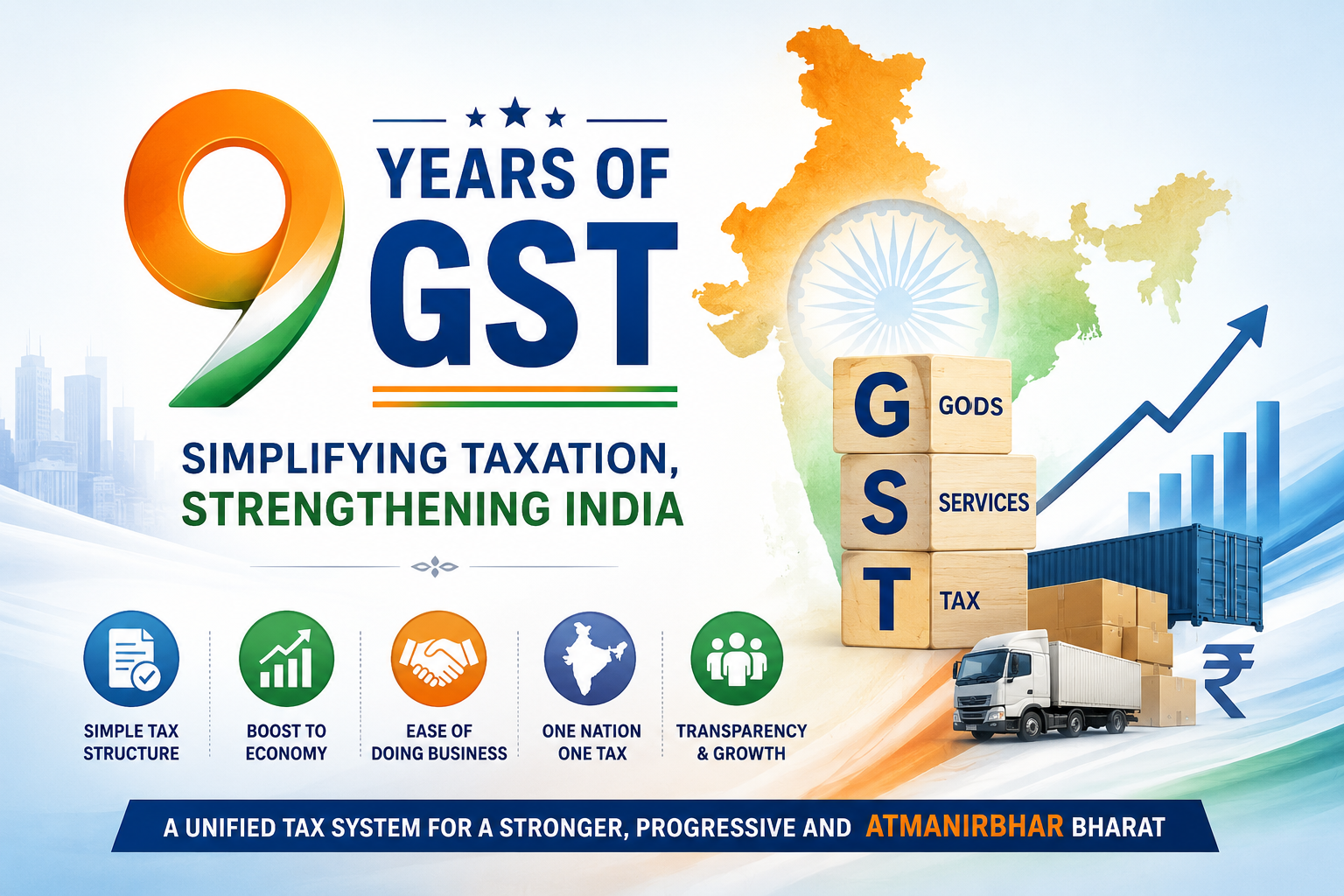
On July 1, 2017, India rolled out the Goods and Services Tax. Nine years later, on July 1, 2026, this landmark reform completed a full decade of transformation. It replaced a maze of central and state taxes with one unified system. Today, GST stands as a symbol of “One Nation, One Tax.” It has reshaped how India collects revenue, does business, and grows.
Why India Needed a New Tax System
Before GST, India’s indirect tax system was fragmented and confusing. Businesses faced separate taxes like excise duty, service tax, and VAT. Each state had different rules and rates. As a result, goods often faced tax on tax, known as cascading taxation. This pushed up costs for both businesses and consumers. Long queues of trucks at state borders were common. Traders lost valuable time and money at every checkpoint.
Therefore, the government introduced GST to remove these barriers. GST subsumed 17 different taxes and 13 cesses into a common framework. Consequently, India moved toward a single, unified national market.
How GST Works
GST operates as a destination-based consumption tax. In other words, the tax reaches the state where goods or services are finally used. It covers nearly all goods and services, except alcohol for human consumption. Additionally, GST follows a dual structure. The Centre collects Central GST, while states collect State GST on transactions within their borders. For inter-state trade, the government levies Integrated GST instead.
Meanwhile, the GST Council guides every major decision. This council brings the Centre and states together at one table. As a result, it has strengthened cooperative federalism in India. The Goods and Services Tax Network, jointly owned by the Centre and states, powers the digital backbone of this entire system.
Growth in Numbers Over Nine Years
The numbers tell a compelling story of expansion. In 2017, only 66.5 lakh taxpayers were registered under GST. By May 2026, this figure had grown to 1.65 crore. Clearly, more businesses have entered the formal economy.
Revenue collections have shown similar momentum. Gross GST collections stood at around ₹7.4 lakh crore in 2017-18. By 2025-26, this number had climbed to nearly ₹22.27 lakh crore. Furthermore, collections during April and May 2026 alone touched ₹4.37 lakh crore. This steady rise reflects stronger compliance and growing economic activity across the country.
Digital Reforms That Changed Everything
Perhaps the biggest shift under GST has been digitization. Earlier, tax administration relied heavily on paperwork and manual checks. Now, businesses file returns and upload invoices through one common online portal. The e-way bill system, launched in 2018, let goods move across states without physical barriers. Similarly, e-invoicing began in 2020 for large taxpayers. Over time, it expanded to cover smaller businesses too.
These digital tools created a transparent audit trail. Automated input tax credit matching further reduced errors and fraud. Together, these systems cut down manual intervention significantly. As a result, tax administration became faster, fairer, and more reliable.
The Arrival of GST 2.0
In 2025, India witnessed the next major chapter of this reform. The 56th GST Council Meeting approved a set of next-generation changes. These reforms, known as GST 2.0, took effect on September 22, 2025. Most goods now fall under two simple slabs: 5 percent and 18 percent. However, luxury items and harmful products like tobacco attract a higher 40 percent rate.
Additionally, essential medicines and insurance products gained new exemptions. Refund processes became quicker, and compliance procedures grew simpler. Small businesses, exporters, and farmers benefited noticeably from these changes. Meanwhile, the government also worked to correct inverted duty structures in key sectors.
Challenges That Still Remain
Despite this progress, some concerns continue to surround GST. Several states worry about revenue losses after the compensation mechanism ended. Moreover, the pace of revenue growth has slowed compared to earlier years. This raises questions about long-term revenue stability.
Petroleum products still remain outside the GST framework. Consequently, cascading taxation persists in parts of the logistics and manufacturing sectors. Additionally, removing input tax credit from healthcare and insurance products may raise costs for providers. These issues highlight that GST remains a work in progress, not a finished project.
The Road Ahead for GST
Looking forward, several priorities can strengthen this reform further. First, artificial intelligence could help detect fake invoices more effectively. Second, broadening the tax base would improve revenue stability over time. Third, continued dialogue through the GST Council can address state-level concerns. Finally, faster dispute resolution through the GST Appellate Tribunal can restore taxpayer confidence.
As India aims to become a developed nation by 2047, GST plays a central role in that journey. It has simplified taxation, boosted trade, and strengthened the bond between the Centre and states. Ultimately, the nine-year journey of GST proves one thing clearly. Meaningful reform is possible when policy vision meets modern technology.
Conclusion
GST has moved far beyond being just a tax reform. It has become a pillar of India’s economic governance. Over nine years, it has formalized businesses, digitized compliance, and unified markets across the country. Challenges remain, and refinements will continue. Even so, GST has undoubtedly made India’s tax system simpler, fairer, and more transparent.
Recent Comments