
A New Era for Ultra Mega, Mega, and Large Enterprises
Haryana has taken a bold step forward. The state government has notified the Make in Haryana Industrial Policy, 2026. This policy replaces the earlier Haryana Enterprises and Employment Policy, 2020. It came into effect on 26 May 2026. Consequently, it will remain in force for five years, unless amended sooner.
This new framework focuses on a specific group of businesses. It covers Ultra Mega, Mega, and Large enterprises only. Meanwhile, smaller businesses will get support through a separate MSME policy. This split allows the government to design sharper, more targeted incentives.
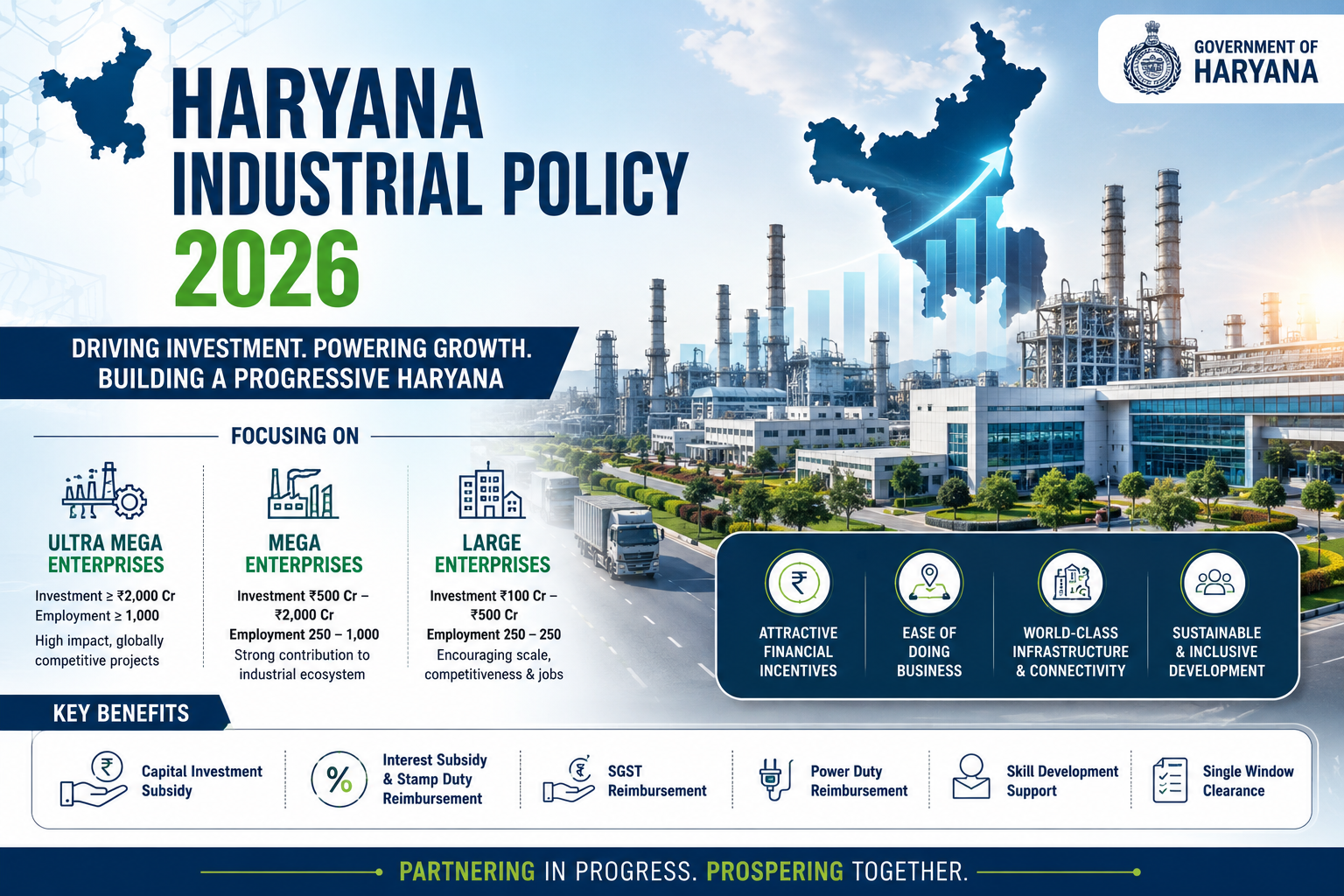
Why This Policy Matters
Haryana already contributes significantly to India’s economy. In fact, the state generates 3.6 percent of India’s GDP. It does this while occupying just 1.3 percent of the country’s land area. Therefore, the government wants to build on this strength.
The policy aims high. It targets over five lakh crore rupees in fresh investment. Additionally, it hopes to generate ten lakh new jobs. The plan also seeks to double the state’s merchandise exports over five years.
Moving Beyond Old Classifications
Previously, Haryana used a Block A, B, C, and D system. This system grouped regions by development level. However, the new policy scraps this approach entirely. Instead, it introduces four fresh categories for balanced growth.
These categories are Prime Focus Areas, Sub-Prime Areas, Intermediate Areas, and Core Areas. Prime Focus Areas are the least developed regions. As a result, they receive the highest incentives. Core Areas, by contrast, are well-established industrial hubs. Therefore, they receive comparatively lower incentives, since infrastructure there is already strong.
Understanding the Enterprise Categories
The policy defines three enterprise types clearly. Each has its own investment threshold. This structure helps investors understand exactly where they fit.
Large Projects need a Fixed Capital Investment above INR 125 crore. This threshold stays the same across all locations.
Mega Projects have location-based thresholds. In Core Areas, the minimum investment is INR 700 crore. Intermediate Areas require INR 600 crore. Sub-Prime Areas need INR 500 crore. Prime Focus Areas require just INR 400 crore.
Ultra Mega Projects demand much larger investments. Core Areas need INR 6,000 crore. Intermediate Areas require INR 4,500 crore. Sub-Prime Areas need INR 3,000 crore. Prime Focus Areas require a minimum of INR 1,500 crore.
This tiered structure rewards investment in underdeveloped regions. Consequently, it encourages balanced growth across the entire state.
Sectors That Get Priority Treatment
The policy identifies several future-focused industries. These sectors will receive special attention and stronger incentives. Electric vehicles top this list, alongside semiconductors and electronics manufacturing.
Other priority sectors include defence and aerospace, and renewable energy. Green hydrogen, pharmaceuticals, and medical devices also feature prominently. Furthermore, the list covers textiles, auto components, and agro-food processing.
Additional sectors include leather, footwear, and electronic waste recycling. Rare earth materials and critical minerals also make the cut. Toys, sports equipment, and advanced engineering round out this ambitious list.
Fiscal Incentives That Drive Real Value
Money matters most to investors. Thus, this policy offers several strong financial benefits. These incentives aim to reduce the actual cost of doing business.
SGST Reimbursement
Net SGST reimbursement forms a central pillar of this policy. Where B2C sales exceed 50 percent within Haryana, reimbursement ranges from 30 to 70 percent. This benefit depends on the project’s location category.
Where B2C sales fall below 50 percent, reimbursement ranges from 20 to 60 percent. Large units receive this benefit for seven years. Mega projects get it for ten years. Ultra Mega projects enjoy this benefit for up to twelve years.
Capital Subsidy
Capital subsidy offers another major boost. Eligible projects can receive between 2.5 and 20 percent of Eligible Capital Expenditure. Location and project category determine the exact percentage.
Notably, Mega and Ultra Mega projects can negotiate customised packages. These special packages may offer benefits up to 30 percent of expenditure. This flexibility helps Haryana compete for major strategic investments.
Stamp Duty and Electricity Benefits
Stamp duty exemption ranges from 30 to 100 percent. Again, the location category determines the exact figure. Mega and Ultra Mega projects may secure full reimbursement through customised deals.
Electricity duty reimbursement can reach 100 percent as well. This benefit typically lasts between three and ten years. However, customised packages may extend this benefit up to twenty years.
Employment Generation Support
Job creation receives strong backing under this policy. Employment generation subsidies remain available for up to ten years. Benefits can reach 100 to 120 percent of average gross monthly salary.
The policy also supports recruitment through Haryana Kaushal Rozgar Nigam. This scheme reimburses employer and employee EPF contributions. This benefit continues for up to five years.
Innovation and Research Get a Boost
Haryana wants to become an innovation hub too. Therefore, the policy includes dedicated research and development incentives. These benefits target both established companies and standalone research units.
R&D centre incentives cover 50 percent of capital expenditure, excluding land costs. Large Projects can claim up to INR 10 crore. Ultra Mega Projects can claim significantly more, up to INR 50 crore.
Patent commercialisation also receives financial support. Domestic patents can earn incentives up to INR 50 lakh. International patents can earn up to INR 1 crore each, subject to overall caps.
Green and Sustainable Growth
Environmental responsibility features prominently in this policy. Several incentives specifically reward sustainable industrial practices. This approach aligns with global manufacturing trends.
Carbon credit generation earns INR 100 per credit, capped at INR 1 crore per unit. Captive renewable energy projects receive INR 50 lakh per megawatt. Zero Liquid Discharge systems get 50 percent reimbursement, up to INR 10 crore for larger units.
Green building certification also earns rewards. Eligible projects can claim 2 percent of building costs. This benefit caps at INR 5 crore per unit.
Linking with Central Government Schemes
The policy does not operate in isolation. Instead, it connects smoothly with national programmes. Companies already benefiting from schemes like Production Linked Incentives can gain more.
These businesses may opt for additional top-up support. Alternatively, they can choose dedicated support linked to central schemes. This flexibility lets investors pick whichever option suits them best.
What This Means for Investors
This policy signals a genuine shift in approach. The government now acts as a facilitator, not just a regulator. Consequently, ease of doing business becomes a central theme.
The state has also strengthened its Single Window Portal. This digital platform now uses artificial intelligence for faster approvals. Additionally, the policy promotes emerging technologies like blockchain, IoT, and 5G adoption.
For large-scale investors, the message is clear. Haryana wants to become a truly global manufacturing destination. Moreover, it wants to do this while ensuring balanced growth across all its regions.
Looking Ahead
The Make in Haryana Industrial Policy 2026 marks a genuine turning point. It separates large-scale industry support from MSME support. This separation allows sharper, more effective incentive design.
Ultimately, success will depend on implementation. Timely approvals and continued infrastructure development remain crucial. If executed well, however, this policy could cement Haryana’s place among India’s leading industrial states.
Recent Comments