
India’s GST system loses enormous sums to fake invoices every year. Meanwhile, Poland solved a similar problem years ago. Its split-payment mechanism cut VAT fraud dramatically. Could India borrow this idea and protect its own tax revenue?
The Scale of India’s GST Fraud Problem
India’s GST fraud numbers are startling. Between FY21 and FY25, authorities detected tax evasion worth roughly Rs 7.08 lakh crore. Of that, fake input tax credit (ITC) claims made up nearly Rs 1.79 lakh crore.
The trend keeps getting worse. In FY23, officials found Rs 24,140 crore in fake ITC. By FY25, that number jumped to Rs 58,772 crore. Consequently, fraud cases nearly tripled in just two years.
These are not small, isolated scams either. Fraudsters now build entire networks. They register shell companies, forge documents, and route fake transactions through multiple states. As a result, tracking down the real culprits has become far harder.
How Fake ITC Fraud Actually Works
The scheme usually follows a simple pattern. First, fraudsters create fake companies with no real business activity. Then, these companies issue invoices for goods or services that never actually moved.
Real firms use these bogus invoices to claim tax credits they don’t deserve. Meanwhile, money often gets routed through banking channels and returned as cash. Therefore, the paper trail looks legitimate, even though nothing real changed hands.
Officials call this “circular trading.” Multiple companies pass invoices between each other. Eventually, the credit chain loops back to a single beneficiary. By the time investigators catch on, the original shell firm has usually vanished.
What Is Poland’s Split-Payment Mechanism?
Poland faced its own VAT fraud crisis years ago. So, in 2018, the country introduced a solution called the split-payment mechanism, or MPP.
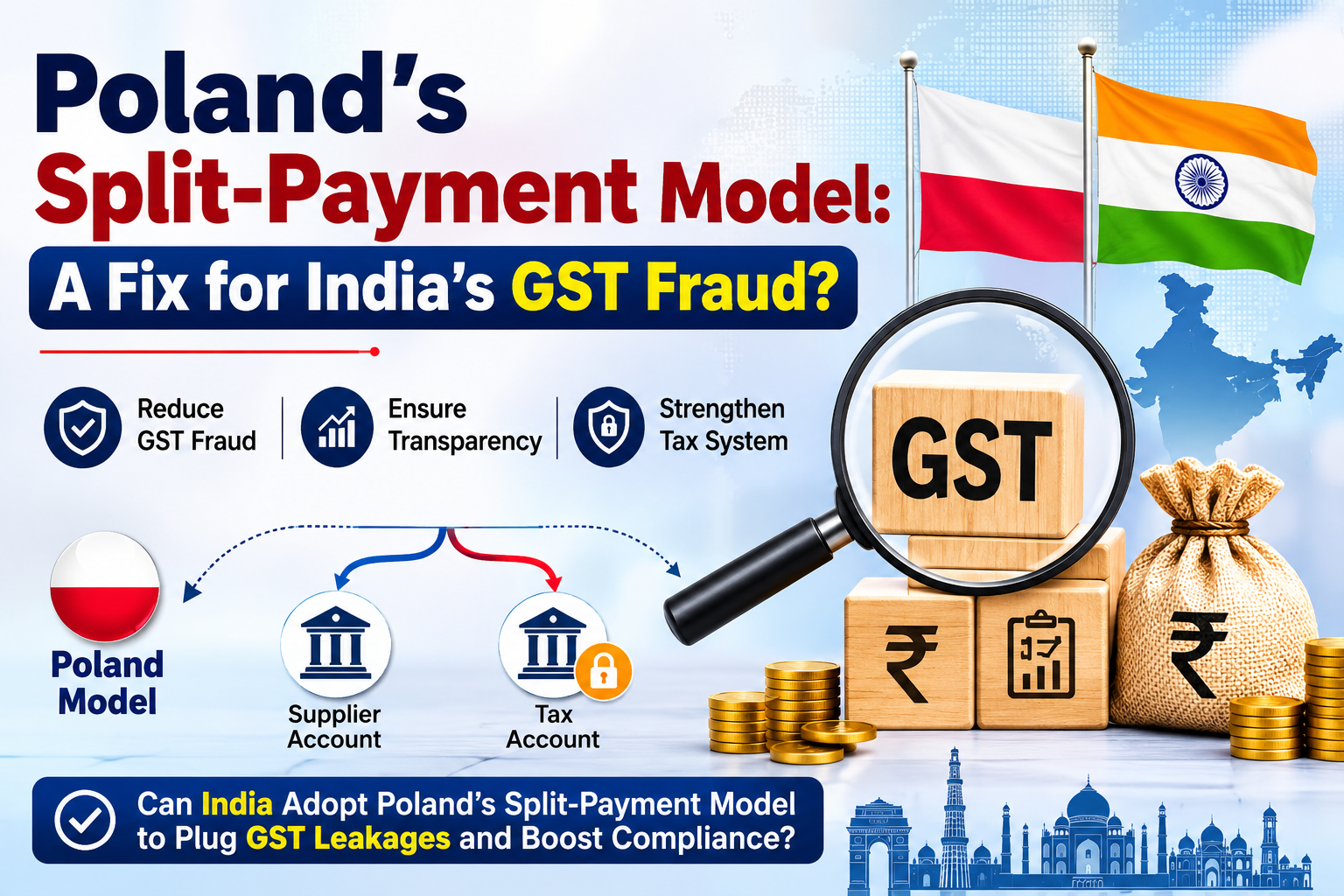
Here’s the basic idea. When a buyer pays an invoice, the payment doesn’t go entirely to the seller. Instead, a bank automatically splits it into two parts. The net amount goes to the seller’s regular account. The VAT portion goes to a separate, restricted VAT account.
This VAT account isn’t a normal bank account, however. The seller technically owns the funds, but their use stays limited. Mostly, sellers can use this money only to settle their own tax obligations. This restriction is the key to the entire system.
Why Split Payment Works So Well
The logic behind split payment is elegant. Fraudsters typically collect VAT from buyers, then disappear before paying it to the tax office. Split payment removes that opportunity entirely.
Since the VAT amount never touches the seller’s main account, it cannot be misused or hidden. Instead, it sits in a ring-fenced account, waiting to be paid to the government. Consequently, the classic “collect and vanish” fraud model becomes far harder to pull off.
The results speak for themselves. In 2018, before mandatory split payment, Polish VAT fraud stood near PLN 5.2 billion. By 2022, that figure had dropped to under PLN 1.7 billion. That’s roughly a 70% reduction in just four years.
Additionally, the number of fraud-related investigations fell too. Fewer cases meant fewer resources spent chasing criminals. Poland’s tax authorities could then focus on genuine compliance issues instead.
How Poland’s System Is Structured
Split payment in Poland isn’t applied to every single transaction. Instead, it targets high-risk sectors specifically. These include steel, electronics, fuels, construction services, and waste management.
The mechanism becomes mandatory under certain conditions. First, the invoice must involve goods or services listed in Annex 15 of Poland’s VAT Act. Second, the total invoice value must exceed PLN 15,000 gross.
This targeted approach matters. Rather than burdening every business, Poland focused on industries most vulnerable to fraud. As a result, compliance costs stayed manageable for the wider economy.
The European Union recognized this success too. In February 2025, the EU Council extended Poland’s authorization to keep using mandatory split payment until February 2028.
Could India Adapt This Model?
India’s GST framework already shares some features with Poland’s system. E-invoicing, e-way bills, and AI-based risk scoring all exist today. However, none of these tools physically separate GST payments from business revenue.
A split-payment style system could close that gap. If GST amounts moved directly into government-linked accounts, fraudsters would lose their main strategy entirely. They could no longer collect tax money and simply keep it.
Naturally, India’s economy is far larger and more diverse than Poland’s. Therefore, any rollout would likely need a phased approach. High-risk sectors, similar to Poland’s targeted list, would make a logical starting point.
Challenges India Would Need to Address
Implementing split payment isn’t without hurdles, though. Poland’s own businesses report cash-flow strain. Construction and electronics firms, for example, often have 15-20% of their working capital frozen in VAT accounts.
India would face similar concerns, likely at a much larger scale. Small and medium businesses might struggle most, since their cash flow margins tend to be tighter. Thus, any policy design would need built-in flexibility for smaller taxpayers.
Banking infrastructure also matters here. Poland’s banks automatically create VAT accounts for every business. India’s banking system would need similar automation across millions of GST-registered entities. This is a massive technical undertaking.
Furthermore, coordination between GSTN, the banking sector, and state tax authorities would need to be seamless. Otherwise, delays or technical glitches could disrupt legitimate businesses unfairly.
A Targeted Rollout Makes Sense
Given these challenges, a full nationwide launch seems impractical right now. Instead, India could pilot split payment within its highest-fraud sectors first. Pharmaceuticals, metals, and certain trading sectors seem like reasonable starting points.
This mirrors exactly what Poland did back in 2018. The country began cautiously, then expanded coverage gradually. India’s GST Council could follow a similar, staged roadmap.
Pilot programs would also generate valuable data. Officials could measure the real-world impact on fraud detection and business cash flow. Subsequently, they could adjust thresholds or expand coverage based on genuine evidence.
The Bigger Picture for GST Revenue
India’s GST evasion numbers demand serious action. Rs 58,772 crore in a single year is not a minor leakage; it’s a systemic vulnerability. Existing tools like e-invoicing help, but they haven’t stopped the problem.
Poland’s experience shows that structural fixes can work better than detection alone. Instead of only chasing fraud after it happens, split payment prevents much of it upfront. That shift in approach, from reactive to preventive, is what makes the model so compelling.
Ultimately, no single policy will eliminate GST fraud completely. However, split payment offers a proven, measurable way to shrink the problem significantly. Given Poland’s 70% fraud reduction, India’s policymakers have good reason to study this model closely.
Recent Comments