
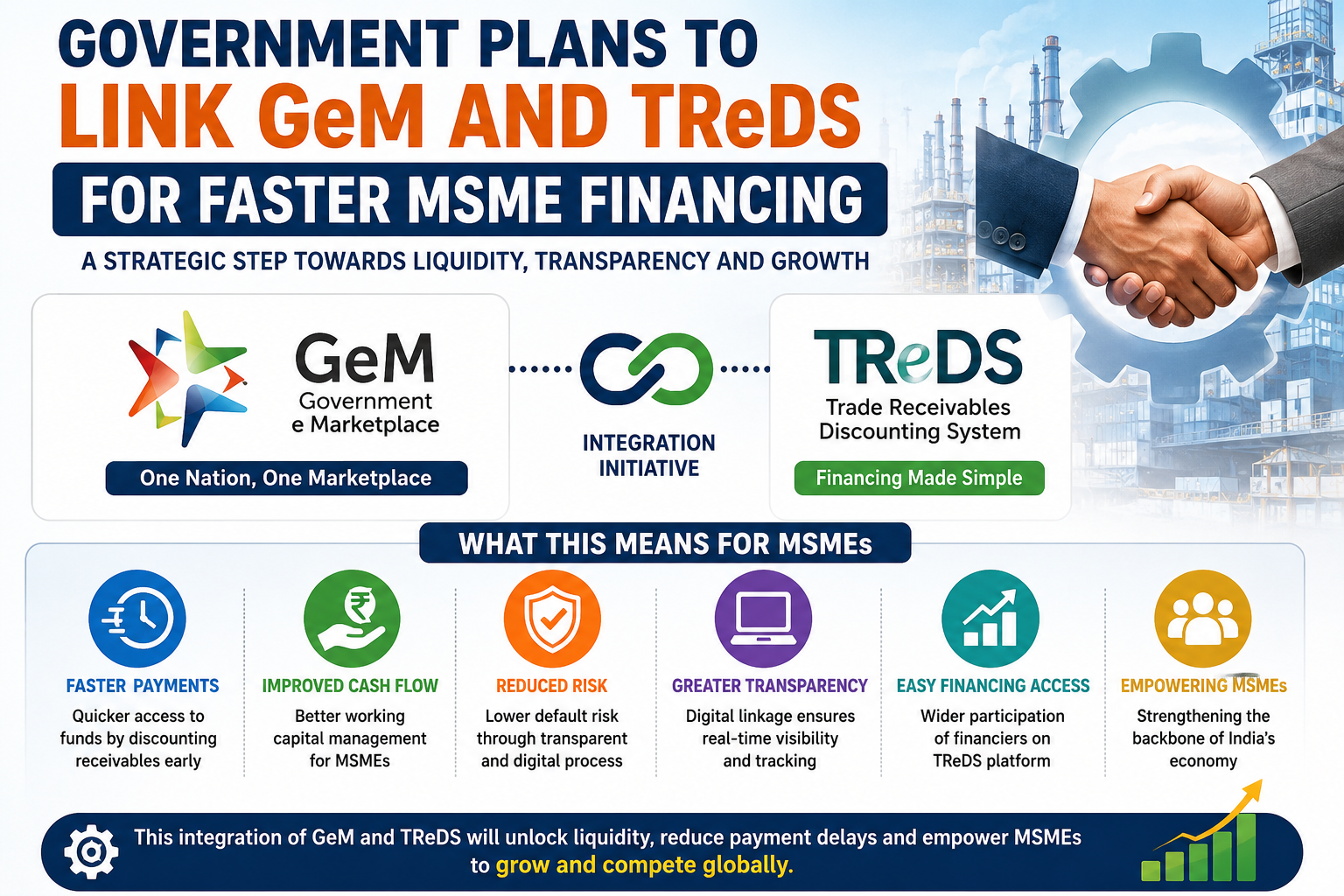
India’s small businesses often wait months for payments. This delay chokes their working capital. However, a new government plan aims to fix this problem. The plan involves linking two digital platforms: GeM and TReDS.
What Are GeM and TReDS?
GeM stands for Government e-Marketplace. It is an online portal where government departments buy goods and services. Meanwhile, TReDS stands for Trade Receivables Discounting System. This platform helps small businesses convert unpaid invoices into instant cash.
Currently, these two systems work separately. A small business owner sells goods through GeM. Then, that owner must manually upload invoice details to TReDS. This process wastes time and creates room for errors.
Why the Government Wants to Link Them
The idea was first announced in the Union Budget for 2026-27. Finance Minister Nirmala Sitharaman proposed several reforms for MSMEs. Linking GeM with TReDS was one of her key proposals.
According to the plan, GeM will share government purchase data directly with TReDS. As a result, financiers will see verified invoice information instantly. This transparency should encourage banks to offer cheaper loans.
Additionally, the risk for lenders drops significantly. Government-backed invoices are considered safe and reliable. Therefore, financiers can offer better interest rates to MSME suppliers.
A Related Step Already Taken
While the full GeM-TReDS link is still being developed, one related step has already happened. On June 30, 2026, the government issued an important notification. This notification made TReDS mandatory for all Central Public Sector Enterprises, known as CPSEs.
Under this rule, every CPSE must now settle MSME invoice payments through TReDS. Previously, this practice was voluntary for many enterprises. Consequently, this mandate ensures a steady flow of invoices onto the platform.
This move builds a strong foundation for the larger GeM-TReDS integration. More invoices on TReDS mean more data for financiers to evaluate. Thus, the mandate supports the government’s broader financing goals.
How This Helps Small Businesses
Delayed payments remain one of the biggest challenges for MSMEs in India. Many suppliers wait sixty to ninety days for payment. During this wait, their working capital stays locked up.
With TReDS, businesses can sell their invoices to financiers early. Banks and non-banking financial companies bid competitively for these invoices. Suppliers then receive funds within twenty-four to forty-eight hours.
Importantly, this financing requires no collateral from the seller. Banks and NBFCs take on the risk instead. This structure makes credit more accessible to smaller enterprises.
Additional Support Measures
The government has not stopped at just linking these platforms. Several other reforms accompany this initiative. Together, they aim to strengthen the entire MSME financing ecosystem.
First, a credit guarantee mechanism now supports invoice discounting on TReDS. This guarantee comes through the Credit Guarantee Fund Trust for Micro and Small Enterprises, or CGTMSE. As a result, banks feel more confident lending to smaller, riskier businesses.
Second, the government plans to treat TReDS receivables as asset-backed securities. This move would create a secondary market for these invoices. Consequently, long-term investors like mutual funds and insurance companies could participate.
Furthermore, TReDS platforms have already shown impressive growth. Invoice discounting increased from forty thousand crore rupees in FY22. By FY26, this figure reached three point four seven trillion rupees.
Industry Reactions
Industry leaders have welcomed these reforms enthusiastically. Vinod Kumar, president of the India SME Forum, called the changes significant. He explained that invoices will now convert into tradable securities for investors.
Similarly, Ketan Gaikwad, who leads RXIL, praised the GeM-TReDS integration plan. He noted that this link will help suppliers get quicker, cheaper financing. Overall, industry voices see this as a meaningful step forward.
What This Means Going Forward
The complete integration between GeM and TReDS is still developing. Nevertheless, the groundwork has already begun through recent notifications. The mandatory TReDS rule for CPSEs marks real progress.
Once fully implemented, this system could transform MSME financing in India. Suppliers would gain faster access to funds. Additionally, financiers would gain better data for making lending decisions.
For millions of small business owners across India, this reform offers real hope. Faster payments mean healthier cash flow. In turn, healthier cash flow allows businesses to grow, hire more workers, and invest confidently in their future.
Conclusion
Linking GeM with TReDS represents a smart, practical solution to an old problem. Small businesses have struggled with payment delays for years. Now, digital integration promises to ease that burden significantly.
While full implementation takes time, early steps show strong commitment. The June 2026 mandate proves the government is serious. Small business owners should watch this space closely, since these changes could reshape how they manage cash flow.
Recent Comments