
What Is the Corporate Mitra Scheme?
India’s small businesses have long struggled with one big problem. Managing regulatory paperwork while also running daily operations is exhausting. Consequently, many MSMEs fall behind on compliance without even realising it.
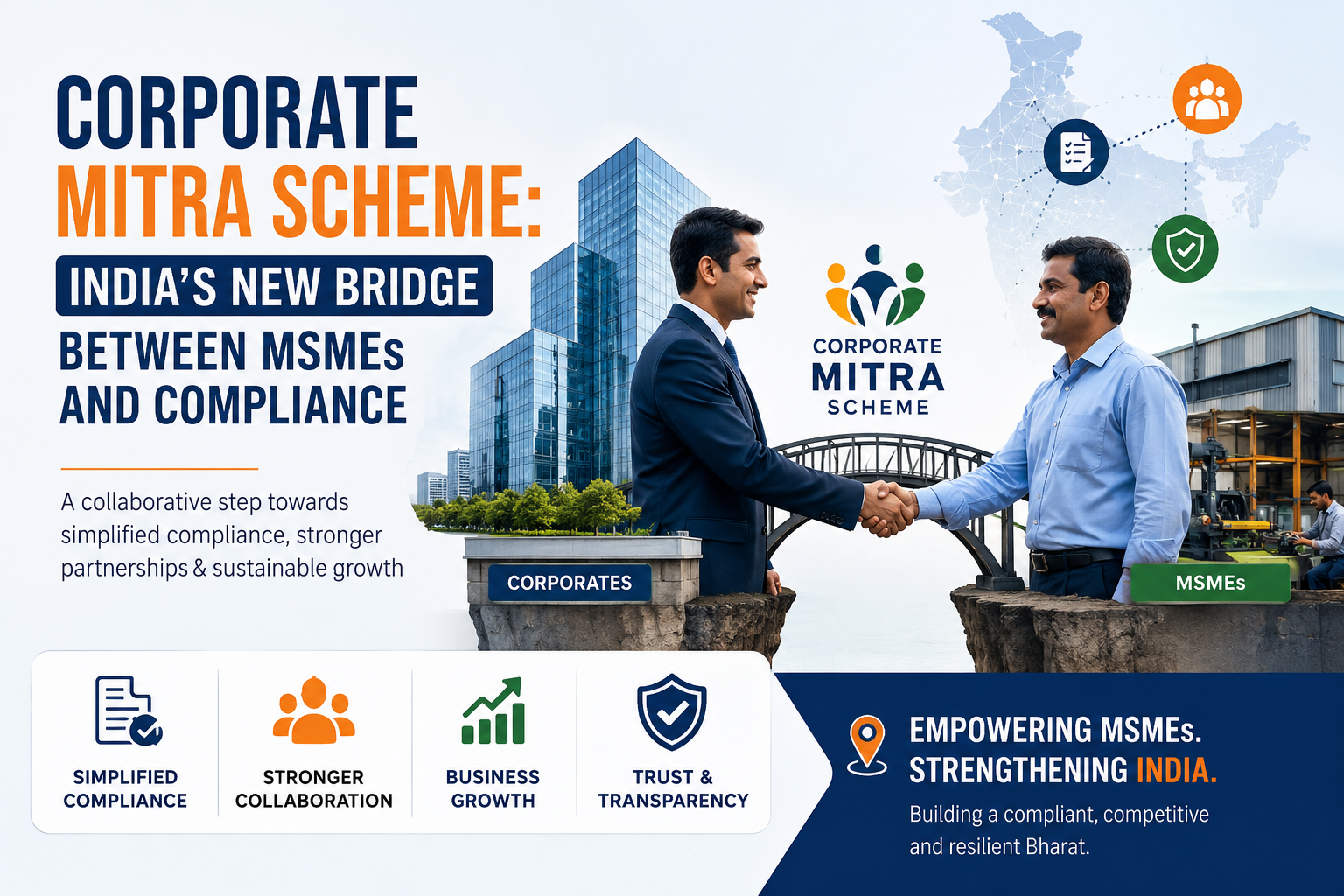
To solve this, the government introduced a powerful new initiative. The Union Budget 2026–27 proposed the creation of a new cadre of accredited para-professionals called “Corporate Mitras” to help MSMEs meet regulatory and compliance requirements at affordable costs. The word “Mitra” simply means “friend” in Hindi. Therefore, these professionals are, quite literally, a business-friendly helping hand.
Furthermore, the proposal forms part of a broader set of measures announced in the Budget to strengthen the MSME ecosystem.
Why Was This Scheme Needed?
India’s MSME sector is not small by any measure. In fact, the MSME sector accounts for nearly 35.4% of manufacturing and around 48.58% of exports and 31.1% of GDP. With over 7.47 crore enterprises employing more than 32.82 crore people, the sector is the second-largest employer after agriculture.
Despite this enormous size, however, many small businesses lack access to professional financial and legal advice. Professional services are especially limited in Tier II and Tier III towns. As a result, MSMEs in smaller cities often pay more for compliance help or miss important deadlines altogether.
The Corporate Mitra Scheme, therefore, directly addresses this critical gap.
Who Announced It and When?
Finance Minister Nirmala Sitharaman, in the Union Budget 2026–27 presented on February 1, said: “Government will facilitate professional institutions such as ICAI, ICSI, ICMAI to design short-term, modular courses and practical tools to develop a cadre of ‘Corporate Mitras’, especially in Tier-II and Tier-III towns. These accredited para-professionals will help MSMEs meet compliance requirements at affordable costs.”
Subsequently, the Ministry of Corporate Affairs (MCA) took charge of rolling out the scheme. Finally, just this week, guidelines were officially released and key partnerships were formalised.
The MoU: A Major Milestone
The most significant development so far has been the signing of a formal agreement. ICAI, ICSI, ICoAI, and IIT Madras have come together under the Ministry of Corporate Affairs to launch the Corporate Mitra Scheme. The collaboration was formalized through a Memorandum of Understanding (MoU), marking a significant milestone in the implementation of the scheme announced in the Union Budget 2026–27.
Moreover, each institution brings unique strengths to the programme. ICAI, ICSI, and ICMAI will contribute professional expertise and academic support, while IIT Madras will play a role in the knowledge and training ecosystem.
What Will Corporate Mitras Actually Do?
So what exactly will these trained professionals help with? Corporate Mitras will provide support in areas such as accounting, taxation, banking, financial management, legal and secretarial practices, and cost and management accounting.
Additionally, Corporate Mitra guides business owners through suitable loan schemes, required documents, and the complete application process—without the need for expensive consultants. It also keeps MSMEs updated on changes in GST and compliance and explains what needs to be done in simple, understandable language.
In short, they handle the routine but critical tasks that often overwhelm small business owners.
How the 12-Month Training Programme Works
One of the most important aspects of the scheme is its structured training format. Candidates will undergo a 12-month structured program comprising six months of academic learning — 150 hours of expert-led online sessions — followed by six months of on-the-job training with professional firms.
After completing both phases, successful participants will be awarded the Corporate Mitra Certificate after periodic assessments and a final evaluation.
This approach ensures that Corporate Mitras are not just theoretically trained. Instead, they gain real-world experience before they start helping businesses.
Who Can Apply?
The scheme casts a wide net when it comes to eligibility. Eligibility is open to Indian nationals up to 30 years of age who are graduates or final-year students. Registration will be on a first-come, first-served basis.
This means students from any stream can apply, including arts, science, or commerce. Any graduate from science, arts, or business administration can enrol.
Furthermore, the portal-driven approach will allow applicants to register online, track progress, and receive certification digitally. This makes the process simple and accessible even from remote areas.
Course Fee and Concessions
Affordability is a key feature of this programme. The course fee has been set at ₹3,000 plus GST, with a 50% concession for women candidates and those from North-Eastern states, Himalayan regions, Andaman & Nicobar Islands, and Lakshadweep.
This makes the scheme especially inclusive. Young people from underserved regions can now access professional training at a very reasonable cost.
Benefits for MSMEs
From the MSME side, the advantages are equally significant. The Corporate Mitra Scheme is designed to create a win-win model for both businesses and aspiring professionals. For MSMEs, it offers access to trained personnel capable of assisting with regulatory compliance, accounting, taxation, and business management functions.
Moreover, basic guidance and information support will be provided at little or no cost, as it is a government-backed initiative.
Importantly, however, Corporate Mitra will not replace a CA. It supports routine compliance and guidance, while complex matters will still need professionals.
Benefits for Young Professionals
The scheme equally opens new doors for India’s youth. For graduates and students, the programme provides structured learning, practical exposure, and professional certification, helping improve employability in the corporate and compliance ecosystem.
Additionally, following the training, candidates may get interested in becoming a chartered accountant and could even enrol for the CA course. Thus, the scheme also serves as a career launchpad.
The CSR Angle
One notable discussion around the scheme involves Corporate Social Responsibility (CSR). The Corporate Law Committee of ICAI examined the CSR implications of trainee absorption and recommended that vocational training expenditure may qualify as CSR, while post-employment costs should be treated as normal business expenditure.
However, it has also been suggested to remove the provision of CSR funds as a requirement of the scheme and for the payment of the stipend. This would enable CA firms and other professional institutes to participate more easily.
Bigger Picture: Viksit Bharat 2047
The Corporate Mitra Scheme fits neatly into India’s long-term growth story. The initiative aims to build a skilled talent pool to ease compliance burdens for MSMEs, thereby promoting the government’s vision of Viksit Bharat.
Furthermore, as India continues its journey towards becoming a developed economy, initiatives such as the Corporate Mitra Scheme are expected to play a crucial role in enhancing business compliance, promoting entrepreneurship, and fostering sustainable economic growth.
Conclusion
The Corporate Mitra Scheme is more than just a training programme. It is a thoughtful solution to a deeply rooted problem. Millions of small businesses across India have always needed affordable, reliable, and local compliance support. Now, that support is on its way.
With top institutions like ICAI, ICSI, ICMAI, and IIT Madras on board, the quality of training is assured. Moreover, the scheme’s inclusive pricing, digital registration, and focus on Tier II and III towns show that the government means business. If implemented well, Corporate Mitras could truly become the trusted friends that India’s MSMEs have always needed.
Recent Comments